Showing posts with label hens. Show all posts

Saturday, December 5, 2015

Avian Influenza and Small Flock Biosecurity

Whether we belong to 4 Chesapeake Hens, Hampton Roads Hens, or some other group, regional chicken keepers want to keep our backyard micro-flocks healthy. My husband, Don, and I attended a presentation in Suffolk on Wednesday with information on how to do that. The presenter was Dr. Tom Ray, DVM, MPH, VMO/Epidemiology, a veterinarian  who specializes in livestock. Aaron Miller, an AHT veterinary technician from Virginia Beach, assisted him. Both work with the USDA, a government agency, to raise public awareness to prevent the spread of communicable diseases in poultry and livestock.

A major concern right now is Avian Influenza or Bird Flu. It thrives in cooler temperatures and in humid environments and survives freezing. Wild birds carry it, particularly waterfowl, often without showing symptoms. It then gets spread by people and equipment, particularly on shoes and vehicles. There are two kinds: "low path," and "high path," depending on how pathogenic  the disease is. Low path is common, and an owner might not know their bird(s) have it unless they are tested, but the viruses mutate easily and can mutate into the high path type.

High path spreads rapidly, has a high mortality rate, and has a severe impact on trade, pets, backyard flocks, and exhibition birds. A recent outbreak of high path avian influenza was first detected in the U.S. in December of 2014 and ended in June of 2015. It affected 211 commercial flocks, 21 backyard flocks, 5 captive wild-bird facilities, and 100 wild birds in 21 states, mostly in the Mid-West, and cost over one billion dollars plus the lives of almost fifty million turkeys and chickens. Egg prices spiked last spring because of a resulting national shortage of commercial eggs.

Dr. Ray showed slides of turkeys infected with the disease. They suffered terribly, and all died within 24 hours of contracting the disease. The birds practically liquify; he says they are all feather and bones and liquid after 24 hours. (Eww!)

The scary part is there's a possibility the disease could hit the East Coast as waterfowl migrate this year. Officials are testing waterfowl like crazy and so far have only found low path, but flocksters need to keep in mind that can change.

An ounce of prevention is worth a pound of cure. The official term for prevention is "biosecurity." The main ideas are to keep a line of separation between your flock and possible vectors of disease, prevent contamination, and maintain cleanliness. The USDA has a fantastic website with all the details for backyard poultry keepers, so I won't repeat it here, but I urge readers to visit the site for more details.

Dr. Ray recommended cleaning all hard surfaces like shoes to remove mud or organic debris and then using a bleach solution or even Lysol to disinfect. Follow the recommendations on the Lysol can and read labels carefully: some types of Lysol work faster than others. A separate set of clothes and boots for visiting the hen house is also a good habit.

The USDA urges us to report sick birds. Due to the threat of high-path bird flu, the agency is taking calls of a dead chicken or two even more seriously than in the past. Please realize that pathologists prefer freshly dead or almost dead animals for necropsy and testing. Symptoms of avian influenza include swollen and purple-looking wattles and combs. Other symptoms are almost identical to Exotic Newcastle Disease. Watch for:
  • a sudden increase in deaths in a flock;
  • sneezing, gasping, coughing, and nasal discharge; 
  • watery and green diarrhea; lack of energy and poor appetite; 
  • a drop in egg production or soft- or thin-shelled, misshapen eggs. 
Report sick birds to:
  1. Your local Cooperative Extension Office,
  2.  Your local veterinarian or State Veterinarian, or
  3. The USDA Hotline at 866-536-7593. The USDA will come out for free and test your birds and take information from you to keep in a government database in case of future outbreaks.
 Speaking of the government, here is what the investigators will do if they first find a confirmed positive case of high-path avian influenza on a farm or other premises:
  1. Set up a control zone for a ten-mile radius and a buffer zone outside of the control zone.
  2. Set up movement restrictions into and out of the control zone with extra biosecurity measures
  3.  Test everything within it. 
  4. Depopulate infected flocks; see below.
 In the buffer zone, the government will test birds for free with your permission, but within the control zone, the government will test birds (again for free) with or without the owners' permission. This is allowed under Virginia state law.  Inspectors will go door-to-door looking for flocks. If a bird turns up positive for high path, they will "depopulate," meaning kill, the flock using fast and humane methods. Large factory-farms and large backyard flocks are suffocated en mass using a foam; backyard micro-flocks of five to ten birds are preferably wrapped in a towel to keep them calm and gassed with CO2 for ten to fifteen minutes. The incubation period for the disease is five days, so the last 5-10 day's worth of eggs must also be sought out and destroyed.

I know this idea is stressful for those of us who love our birds, but please realize the flock will NOT survive the high-path virus, the birds will suffer terribly dying, and while they die they will shed massive amounts of the virus. They will increase the risk of contaminating other flocks the longer they live. What seems cruel is actually an act of mercy and a prudent course of action. The government tries to depopulate the flock within 24 hours of receiving a positive result to minimize both suffering and the spread of disease. There is an indemnity process through which the government will pay for the death of live animals. The best way to avoid this awful scenario is to practice good biosecurity. Read these 6 Simple Steps we all can follow to keep our birds safe and healthy.

 We asked about the safest way to dispose of a dead chicken in general. Dr. Ray said the virus and other chicken diseases do not survive heat very well, so he recommends disposing of them in a burn barrel.

We should all follow good biosecurity practices. Even if we trust that nature and good care will protect our flocks, we should have a plan to "step up to" if high-path avian influenza is reported on the East Coast in the coming months.  As a public service, Wendy Camacho of Hampton Roads Hens has promised to make USDA-approved materials available at workshops and other events in coming months.

Thank you, Carol Bartram of PeCK, for organizing this important presentation for us.


Friday, January 31, 2014

Minerva the Hen at Midway Veterinary Hospital


Minerva the Buff Orpington checks out her veterinarian's office

Minerva, one of two Buff Orpington hens in our mixed flock of five backyard layers, has developed redness on her feet and legs for a few weeks now. My husband Don and I tried to treat her ourselves, first using petroleum jelly, and when that seemed to make things worse, we tried Bag Balm. The latter seemed to help a little for a while, but it made her feathers around her legs very greasy and dirty looking, and I was afraid she would have trouble keeping her feet warm with the extremely cold weather we've been having. And she certainly wasn't healing up to my liking.

Minerva's red legs caused us concerned. The dirty feathers were caused by our attempts to treat her.


Nights have dropped into the teens for several nights in a row and remained freezing even during the day, a rarity for this corner of Virginia. Most recently we had about 8" of snow, also a rare event.

Don and I had reached the end of our limited ability to treat Minverva, so we took her to Dr. Tony Poutous at Midway Veterinary Hospital in Chesapeake, VA. We have had positive experiences bringing our hens to visit Dr. Poutous before as evidenced in my earlier post about our visit with Athena, our Delaware hen. Here are highlights from Minerva's visit:

Minerva was weighed in, of course!

Dr. Poutous gave Minerva a through physical--maybe more thorough than she liked at times! Say Aaah!

Other parts of the exam were less objectionable. Dr. Poutous listened to her heart and respiratory system.
Overall, Dr. Poutous found Minerva to be in good health, which was a relief. He took scrapings of her legs to check for bacteria or fungal infections or even signs of mites. But he found nothing significant. We decided it was best not to treat her further and to keep an eye on her legs. I will definitely give our vet a call if Minerva's signs change or worsen at all. He said if areas turn black, that could mean frostbite, and to bring her back in right away. He said he was willing to treat for mites, even though he hadn't found any, just in case, but I said it was probably best to wait.

I was so relieved she wasn't developing an infection, which had been my fear!

Don asked about continuing with the Bag Balm treatment. Dr. Poutous said that he was concerned the Bag Balm might continue to mess up Minerva's feathers. Considering the cold weather, she might have trouble regulating her body temperature with dirty feathers. She needs clean feathers to keep her legs and feet warm. Without them, she has the potential of coming down with frostbite on her feet. It's not worth the risk.

Minerva the Buff Orpington looks ready to go back to the hen house!

Minerva had taken a much-needed break from laying this fall and early winter, but she already is back to laying an egg almost every day. She is a very reliable layer in spring and early summer, but she has a tendency to go broody after that. She very much would like to be a mother, I think! But that's not manageable under Chesapeake's backyard hen ordinance.

If there are any questions about the ordinance, my own understanding of it is listed here. You are also welcome to like our Facebook page, 4 Chesapeake Hens.

Update: Minerva's legs improved with the spring weather for no apparent reason. In the late spring she went broody again, so I sold her to a local farmer that needed a broody hen to hatch chicks. I get occasional reports that she is loved and doing well.

Thursday, August 15, 2013

City Council Member of the Week

Our grass-roots community group, "4 Chesapeake Hens," found the following approach very useful when we worked to get backyard hens legalized in Chesapeake, Virginia, with certain restrictions. Instead of asking members to contact everyone on City Council all at once, we asked them to contact one Council Member at a time, so that our efforts were more focused and hopefully noticed.

We are not done working for the right to keep our hens, however. City Council voted a sunset clause into the ordinance, which means that if Council does not vote to keep the law by December 20, 2013, our right to keep our hens will lapse. Therefore it is time to contact our elected leadership and share our expectations.

Remember to keep all contact with our elected leadership concise, informed, and polite. This is how our group earned the right to keep hens, and this is how we will continue to keep them. Also remember that most Council Members voted *for* the hen ordinance. We will inform  you which ones did or did not, and we will inform you *why* a Council Member voted against us if we know the reasons. If you email, be sure to include contact information such as your name, address, email address, and telephone number.

10/12/13

Our final "City Council Member of the Week" is Vice Mayor John de Triquet, who voted *against* backyard hens along with Debbie Ritter and Rick West. Dr. de Triquet has been very open and honest about his opposition to backyard hens since the beginning of our group's efforts in Chesapeake. He has been willing to communicate and very polite. He also seems to appreciate the respectful, well-informed way our group has approached hims. Nevertheless, his mind has seemed to be made up. Video is available on YouTube that explains Vice Mayor de Triquet's "no" vote back in November. It's interesting to note that he cites the opinions of health officials in Richmond, yet Richmond has legalized backyard microflocks since last November. If anyone discovers any specifics about his concerns for public health or safety, please let us know! We would like to address them if we can.

Here is his contact information:

Vice Mayor John de Triquet

Council Member
3020 Princess Anne Crescent
Chesapeake, VA 23321

Contact Numbers:

Business: 757-312-9220
Home: 757-484-0542
Fax: 757-484-0014
Ph. Mail: 757-382-6951
E-mail: Johndetriquet@aol.com

10/6/13

This week's "City Council Member of the Week" is Debbie Ritter, who voted *against* backyard hens last November. She has been consistently willing to talk to her constituents and to listen to them, but she has consistently opposed the hens. Her main reason seems to be her perception of residents' "expectations." Be sure to share your own expectations politely when you contact her. Explain that voters' expectations might be different from what she suspects. Video of her explanation when she voted against the hens last November is available on YouTube through Saad Ringa. Thanks, Saad!

Here is her contact information:

S.Z. "Debbie" Ritter

Council Member
732 Schoolhouse Road
Chesapeake, VA 23322

Contact Numbers:

Home: 757-482-4242
Fax: 757-482-6356
Ph. Mail: 757-382-6948
Email: dritter@cityofchesapeake.net

9/29/13

This week's "City Council Member of the Week" is Scott W. Matheson.  He also voted for allowing backyard hens. Be sure to thank Mr. Matheson and ask him to renew the ordinance. Here is his contact information:

Scott W. Matheson

Council Member
725 Watch Island Reach
Chesapeake, VA 23320

Contact Numbers:

Phone: 757-548-3296
Fax: 757-410-9409
Ph. Mail: 757-382-6947
E-mail: scott@scott-matheson.com

9/20/13

Lonnie E. Craig is this week's "City Council Member of the Week." He voted *for* backyard hens last November. Please thank him for doing so and remind him that it is time to extend the law. Here is his contact information:

Lonnie E. Craig

Council Member
3613 S. Battlefield Blvd.
Chesapeake, VA 23322

Contact Numbers:

Home: 757-421-2322
Ph. Mail: 757-382-6946
E-mail: lcraig@cityofchesapeake.net


9/15/13

This week's ""City Council Member of the Week" is Dr. Ella P. Ward. When she voted for the hen ordinance, she said the sunset clause was important to her. She  felt it important for Council to revisit the ordinance this fall in case backyard hens were causing the City or its residents any problems. It is time to remind her that the hens have been a blessing, not a problem, to residents of Chesapeake. We need to make this ordinance permanent so we can continue to enjoy our hens. Here is her contact information:

Dr. Ella P. Ward

Council Member
1517 Pine Grove Lane
Chesapeake, VA 23321

Contact Numbers:

Home: 757-488-6843
Fax: 757-488-4713
Ph. Mail: 757-382-6950
E-mail: eward@cityofchesapeake.net

9/7/13

This week's "City Council Member of the Week" is our Mayor, Alan P. Krasnoff. He voted *for* backyard hens back in November. Please thank him and ask him to do the same the next time the issue is up for a vote. The mayor is interested in helping people from all walks of life, especially those who face challenging circumstances. If chickens have helped you or your family overcome adversity in any way, please be sure to share your story. Here is his contact information according to the City's website:

Dr. Alan P. Krasnoff

Mayor
1006 Cuervo Court
Chesapeake, VA 23322

Contact Numbers:

Business: 757-547-9266
Home: 757-547-8446
Fax: 757-547-9268
Ph. Mail: 757-382-6974
E-mail: akrasnoff@cityofchesapeake.net


8/29/13

Our third "City Council Member of the Week" is  Susan H. "Suzy" Kelly. She voted *for* backyard hens back in November and has told me she "hopes to be able to" vote for them again this fall. She has been one of the more responsive council members to our questions and requests. She has strong interests in environmental concerns, especially water quality. She also has told me that she hoped that backyard hens would not become a divisive issue in our community. Please send her messages reassuring her on both counts. Thank her for her support. Here is her contact information from the City's website:

Susan H. "Suzy" Kelly

Council Member
1716 Lambert Court
Chesapeake, VA 23320

Contact Numbers:

Phone: 757-523-2900
Fax: 757-523-0903
Ph. Mail: 757-213-5115
E-mail: suzy@jokell.com

8/22/13

Our second "City Council Member of the Week" is Dr. Rick West, who has degrees in education. He voted against backyard hens in November, but we are still not sure what his reasons were. In a recent article in the Clipper, West claims he has not changed his opinion but is trying to keep an open mind, particularly since there have been few complaints. Let's thank him for trying to keep an open mind and see if we can find out exactly what his concerns are. If you learn of his reasons, please keep us posted in comments either here or on 4 Chesapeake Hens' Facebook page. Perhaps we can find ways to assuage whatever concerns he may still have.

Dr. Richard W. "Rick" West

Council Member
1144 Fairway Drive
Chesapeake, Va  23320

Contact Numbers:

Home: 757-436-1915
Fax: 757-390-3598
Ph. Mail: 757-382-6952
E-mail: rwest@cityofchesapeake.net


Our first "City Council Member of the Week" is Robert Ike, who is the City Council Member who worked very hard to bring this law to pass. He has always been completely in our corner. Let's start by thanking him for what he has done, and offering to help him as he works toward making this change permanent. Here is his contact information as provided by the City.

8/15/13:

Robert C. Ike, Jr.

Council Member
908 Executive Court, #104
Chesapeake, VA 23320

Contact Numbers:

Home: 757-842-4819
Fax: 757-482-6654
Ph. Mail: 757-382-6956
E-mail: rike@cityofchesapeake.net

Update: On November 26, 2013, Chesapeake City Council voted to make the "hen ordinance" permanent. The meeting may be viewed online:  fast forward to 1:19 to see some great pro-chicken speeches and the City Council's reaction. 

Saturday, June 29, 2013

What I learned from Pat Foreman's Two-Day Intensive Chicken Workshop

I confess, this blog post is late! I participated in a two-day intensive chicken workshop with Pat Foreman, the author of City Chicks, back in early March. I meant to write about the experience months ago, but better late than never. We met at First Landing State Park in Virginia Beach.

Pat Foreman, Chicken Whisperer and Workshop Presenter Extraordinaire!
Pat Foreman's Sidekick, a Rare Chantecler Hen Named Oprah Henfry

 Pat gave us lots of handouts and advice. Much of it I had read in some of her books, but the refresher was useful. I came away realizing that our society and our world need to do more to conserve our soil and our sources of fresh water, which we are rapidly and suicidally depleting. Chicken-keepers can help by employing chickens and their manure in organic gardening.

The chicken-handling portions of the workshop were the parts that were most useful to me. I am much more confident handling my hens and much less likely to accidentally harm them as a result of this experience. I am glad that local chicken-keepers are giving free workshops through 4 Chesapeake Hens and other groups, but I wish that everyone who raises chickens could get to spend the time with Pat that we did.

Here I Am, Talking to My Buff Orpington, Minerva (photo courtesy of Craig Mills)

Oprah and and this participant seem to have hit it off!

Lisa Dearden was Pat's Co-Presenter
My Friend, Lanette, Handles a Gentle Dominique Rooster, a Colonial-Era Breed from Williamsburg
Pat Brought In Some Day-Old Chicks. How FAST They Grow!
Can You Spot the Chick?
This Chick is Hard to Miss!

Some random tidbits that I found useful: avoid the use of particle board in coops because they harbor mites. Pat prefers plastic or metal nest boxes to wood ones, and plastic nest-box liners, for the same reason. Never use cedar shavings in coops because they off-gas and can cause the birds respiratory and other health issues. Aspen shavings are preferred. Sprouting grains improves the nutritional availability to the chicken; they *love* sprouted wheat berries! Heritage breeds of chicken need higher levels of protein than the factory-farm birds, up to 28% of their diet. The shells of chicken eggs, crushed up and fed back to them as a source of calcium, are much more nutritious than crushed oyster shells. NEVER grab and squeeze a laying hen; it can kill hens if you break an egg inside them.

Speaking of eggs, Lisa Dearden demonstrated the differences between pastured eggs and supermarket eggs. She scrambled some of each up, and it's easy to tell the difference. The richer color of the pastured eggs is evidence of superior flavor and nutrition.

Can YOU Tell Which Part of These Scrambled Eggs Came From the Supermarket?
The color of the eggshells, however, has nothing to do with freshness or nutritional content, despite popular belief to the contrary. Still, the variety of colors and sizes is fun and nothing like what you find in stores:

Different Breeds of Chickens Produce Eggs with Different Colors of Shell


Pat recommended Countryside Organics feed. A friend keeps reminding me that it is available at New Earth Farm in Virginia Beach. Maybe next time I need to buy feed I will hunt this down.

For more pictures and another perspective on this workshop, check out this blog post by my good friend and urban homesteader, Lanette Lepper. Unlike me, she managed to post her thoughts in a timely manner. For more about Pat Foreman's workshops, visit Chickens and You.

Sunday, April 14, 2013

Chickens as Lawn Mowers

As regular readers know, I started a community group, "4 Chesapeake Hens," where I live in Virginia. Our group got the law changed to allow up to six "female chickens" on all single-family residential lots with certain restrictions. There are setbacks for the coop from the property line, for example. There is also a sunset clause on the legislation, so the City Council will be revisiting the "hen issue" in October or November.

One of the reasons my husband and I wanted chickens was to help with gardening tasks such as fertilizing, tilling, compost-turning, and organic weed and pest control. What Don and I did not realize until we owned our own chickens is that they do a pretty nice job of helping to maintain parts of our back lawn and sparing us some of the use of our lawn mower. Since gas lawn-mower engines are both noisy and very polluting to the air, I now think our our hens as even more of a benefit to our local environment.

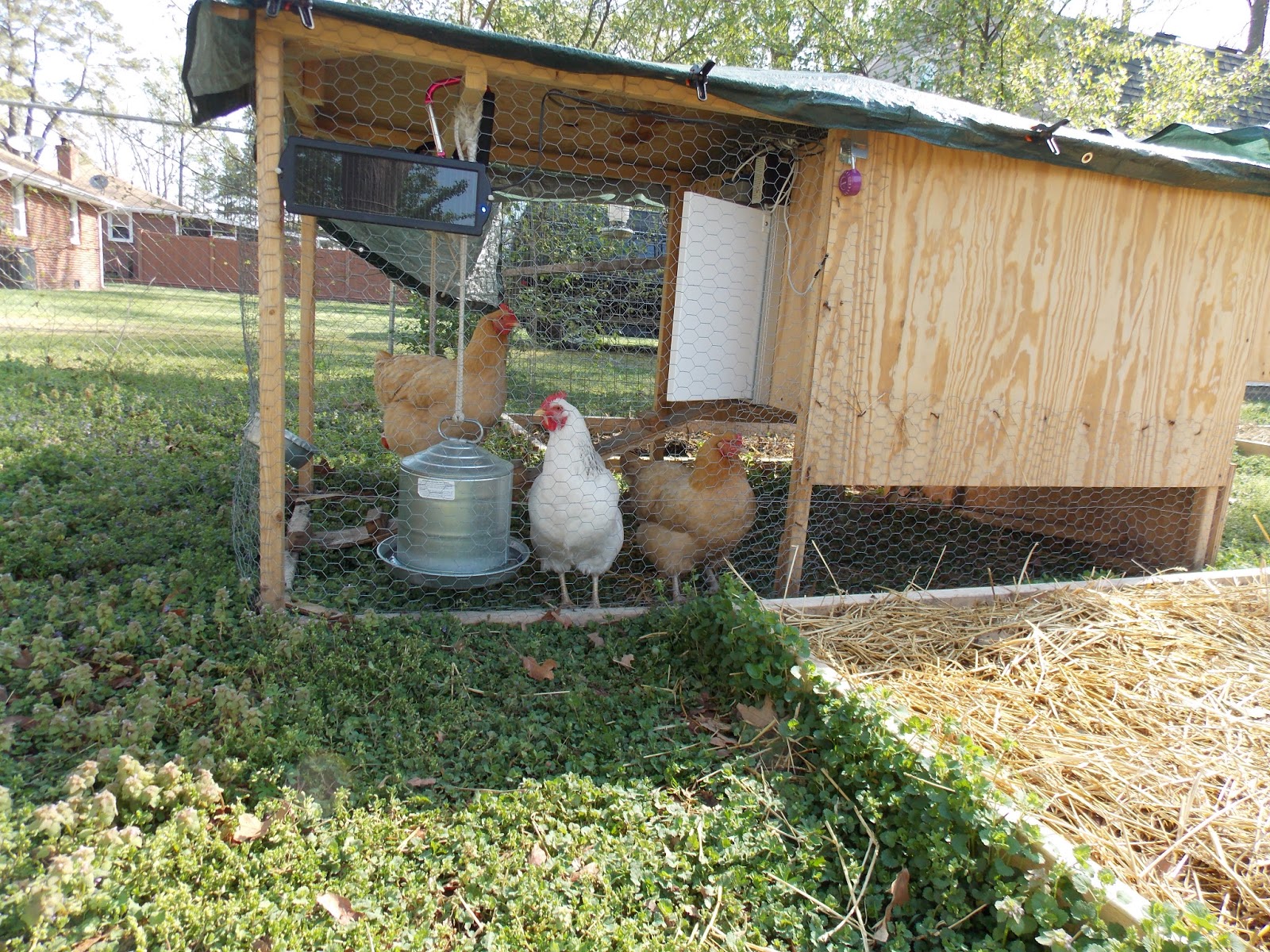
If you don't believe me, that's understandable. Folks picture chickens as dirty, smelly birds that burn the soil. But we are "urban chicksters," and our hens are kept in a portable coop and pen, also called a chicken tractor, that we move around the yard. By moving the pen frequently, we prevent the chickens from burning the soil and scratching and eating it bare. Instead they weed, graze, and slightly fertilize an area before we move them onto new ground.

This spring we had some lawnmower trouble and let the backyard go a little too long before the first mow. Our backyard is also fenced to separate the chicken/garden section from the dogs' run. Check out the differences in these sections of our yard as shown in the following pictures. I snapped them right before tackling the lawn with the mower. Keep in mind that NONE of this lawn has been mowed so far this year:

This is the area that has regularly been visited by the hens and intensively grazed due to the chicken tractor

Don't know what I mean by a chicken tractor? Here are three of our girls saying hello!

The other two are working a compost pile/future garden from a pen attached to the tractor. Where there's no lawn, there's lots of high-carbon organic matter!

Here's an area of the lawn that gets occasional visits by the chickens but is too uneven for the tractor

Here's the same lawn where the chickens never go. The paths have been worn by our three dogs. What a difference!

Interested in seeing some hens up close and personal? Visit us during the Chesapeake Tour de Coop, held next Sunday (April 21, 2013, from Noon to 5 PM, weather permitting).

Monday, January 21, 2013

Chickens at Last!

Regular readers of my blog know that I've been very busy with a group called "4 Chesapeake Hens." Together we got the laws changed in Chesapeake to allow up to six backyard laying hens in residential areas with certain restrictions. Here's a news account of our success. The change was proposed by Councilman Robert Ike and enacted on November 20, 2012.

My poor husband, Don, has been working his tail off ever since. He promised that if I got the law changed, he'd help put together a set-up to keep them. So he's been fencing off about 1/3 of our backyard to try to keep our predatory hound-dogs from killing the poor chickens. He put in a fence and then buried concrete beneath it. Then he started on the chicken coop, which he designed himself. He called it a prototype, figuring he'd make mistakes and want to make changes.

Front View of the new coop with the hanging feeder and waterer


We haven't been 100% happy with the new coop, but Don is already figuring out what to change and how to improve our next one. He's going to split the roof in such a way that we don't have to disturb the chickens at their roost if all we want to do is get in the pen for something. He plans to put in a door on one end and to paint the roof to help keep water out.

Side View of the Coop


Last night I went to a local farm and finally picked my girls up. They're pullets, hatched last spring by a farmer-friend who decided to downsize her flock this year. There are two Buff Orpingtons and a Delaware. Both breeds are "dual-purpose" heritage breeds known for calm temperaments and good laying. I am in love with the Delaware, who seems friendliest and boldest of the three. She'll already peck tidbits out from between my fingertips. The Orpingtons are terrified of me so far. I hope that changes!They don't have names yet, but they will once I've gotten to know their personalities a little better.

Two Buff Orpingtons on the left looking scared; the Delaware on the right looks cautious but curious!


They didn't eat well today and were afraid to come out of their coop, perhaps afraid of our dogs that were running around on their own portion of our backyard. Don and I turned the coop tonight so they can leave the coop without the dogs seeing them, so hopefully that will make them more comfortable. Friends tell me that it will take them a week or so to settle in. Tonight's supposed to turn cold, so I hope they're comfortable enough out there!

Another view of our new flock!
Nest Box from the outside. It has a separate lid that is lifted to easily check for eggs


View of the nest box from inside the coop. The golf ball is to help give the girls the idea of where to lay; hopefully soon!
Update for 1/24/2013: The girls are eating better and starting to act more at home. Hurray!

We are also getting used to incorporating them into our daily schedules. They are not a lot of work, but someone has to be up to feed and water them every morning, and one of us has to be sure to be around to close the coop up at dusk, since we do not have an automatic pop-hole opener. At least, not yet!

Monday, December 3, 2012

Chicken Coop Ideas

"4 Chesapeake Hens" has been getting inquiries about chicken coops. I prefer the idea of a movable chicken tractor, myself. Here are some ideas of compiled over time.


Legalizing coops may open up some opportunities for small businesses, like this one building cute coops: http://helenair.com/news/state-and-regional/with-backyard-chickens-now-legal-in-billings-builder-busy-constructing/article_9ee50e34-1c66-11e2-b848-001a4bcf887a.html


http://www.amazon.com/Handcrafted-Coops-Chicken-Coop-Portable/dp/B002JXW29S/?tag=mell23-20

https://www.facebook.com/photo.php?fbid=10150772201924678&set=a.10150772201414678.410237.143835414677&type=1&theater

http://www.seattlefarmsupply.com/?wpsc-product=kippenhouse-coop

http://www.mypetchicken.com/catalog/Chicken-Coops/The-Clubhouse-Coop-with-Run-Ships-Free-p1167.aspx

Easty and inexpensive chicken coops to build yourself: http://www.motherearthnews.com/do-it-yourself/portable-chicken-coop-zm0z12amzmat.aspx

Free chicken coop plans along with space recommendations: http://pubs.ext.vt.edu/2902/2902-1092/2902-1092_pdf.pdf

Nice how-to guide for backyard flocks from N.C. State: http://www.ces.ncsu.edu/depts/poulsci/tech_manuals/Backyard_Chickens.pdf

Want one built for you? Money’s no object? Check out this offer from Neiman Marcus: http://www.neimanmarcus.com/christmasbook/fantasy.jsp?cid=CBF12_O5415&cidShots=m%2Ca%2Cb%2Cc%2Cz&r=cat44770736&rdesc=The+Fantasy+Gifts&pageName=Beau+Coop&icid=CBF12_O5415

Thursday, November 15, 2012

Crunch Time 4 Chesapeake Hens

Laying hens are back on the agenda for Chesapeake City Council. Our organization, 4 Chesapeake Hens, has been trying to get backyard micro-flocks of six laying hens legalized for single-family residences throughout Chesapeake, VA. (Why six? Click here). The current laws allow chickens only on land zoned agricultural. There is one exception: residents who own RE-1 "residential estates" of three acres or more may keep up to four hens, no roosters, in a pen as household pets. In effect, you must have the money to have substantial land in Chesapeake to raise your own fresh eggs. We have been working hard to change that!

Our organization inexplicably suffered a setback at a Planning Commission hearing, as explained in prior posts: click here for the Commission meeting itself, here for our group's frustration at the lack of commentary by the Commissioners who voted against hens, and here for Commissioner Adam Perry's comments on backyard hens. Our official position is that we support a proposed change to existing ordinances, TA-Z-12-07, with changes to allow up to six hens and the removal of the privacy fencing requirement. The hens will already be required to stay in a pen, and the privacy fence will be an unnecessary and cumbersome financial burden for those who merely want a few fresh eggs!

We have new members joining us on Facebook every day. If you are new and want to know what you can do to help, here is a list:

  1.  Like our Facebook page for the latest news and information.
  2. Print up flyers to distribute in likely places, such as at feed stores or with sympathetic coworkers.
  3. Consider sending an email such as this one to friends who are Chesapeake residents. Be sure to sign it!
  4. Contact the mayor and city council members to let them know how you feel. Be polite and respectful.
  5. Most of all, COME to the City Council meeting on November 20. Some Councilors fail to realize how many residents from all across our city and from all walks of life care about this issue and support hens. Since the Planning Commission voted against us 4-3, there will be a negative recommendation against us. We need a huge show of support to counter this. Wear red, the color of the "Little Red Hen," and bring every supporter you can round up for us. 
The meeting starts at 6:30. If you desire to speak, show up by 6:15. You will need to fill out a speaker card and turn it in before the meeting starts in order to be heard. Plan to limit your remarks to five minutes. Realize you might be required to cut your remarks back to three minutes; speakers are guaranteed three minutes if there are too many speakers. So far we've had no problems getting five, though.

If you care, be there! And bring family, coworkers, and friends.

If you have any questions, post them on Facebook or comment here, and I'll get back to you.  If you want to learn more about urban laying hens, our research page is a great place to start. We also have a YouTube Channel that highlights our efforts in front of City Council and the Planning Commission in recent months. The Planning Commission meeting is especially motivating. Not one person spoke against the hens, several spoke for, but the Commissioners voted against them without one word of explanation: not what I expect from my tax dollars at work!

Update: On November 20, Chesapeake City Council voted 6-3 to allow hens with certain restriction in residential areas.

Sunday, October 21, 2012

Overlay Districts vs. Chesapeake Hens

Our group, 4 Chesapeake Hens, is trying to get micro-flocks of up to six laying hens legalized in residential areas in Chesapeake, Virginia. The Planning Commission has voted against our initial efforts to do this by one vote in a split decision. We may never know the Commissioners' true reasons for voting against us because there was no public discussion or debate against the chickens at the meeting. Those who voted against us have not even given us reasons in our follow-up contacts with them, other than something vague to the effect that the Staff Report seemed thorough and sufficient.

Except that it was not. Our group has researched further information on the Staff Report that we intend to share with City Council. In the meantime, the part of the Staff Report that disturbs me the most is this one:


 ... It's me, again. What bothers me most about this portion of the document is that it is completely clueless about the "urban homesteader" point of view or the other national movements that are behind the interest in gardening. It is clueless regarding WHY an interest in urban chickens is sweeping this nation. Why should hens be banned due to something as arbitrary as an overlay district, if there is nothing intrinsically undesirable about the chickens? We are not asking for a dismantling of these districts, but merely permission to keep a few chickens like any other pet. Doing so will make Chesapeake an even better, more desirable place to live. Residents will be able to enjoy organic gardening and permaculture without leaving their own yards.

Here we are, doing our best to combat urban sprawl and preserve the environment. We also want to live in the residential areas where infrastructure is already in place to support our homes. Some of us are taking older, beat-up homes in residential areas and fixing them up. We hire local remodeling, heating and air-conditioning companies, and other local businesses to do this, thus contributing to the local economy. We generally spend our local dollars as locally as we can.

We want a small spread to reduce our need for lawn mowing because this process takes a lot of time and is very polluting. We are trying to lessen the impact of our properties even more by replacing relatively unproductive lawn that requires mowing with useful vegetable gardens that do not. We desire to live close to our work and recreational activities to save on time and fuel. Our commitment is to residential areas, and we see hens as part of our environmental commitment and as assistants in fertilizing and maintaining these lawns and gardens without the use of fertilizers, herbicides, pesticides, and other products made from petroleum. They will even help us till our garden beds without the use of noisy, smelly, gasoline-powered tools.

While some of us can't afford to move to a farm or an RE-1 residential estate, others do not want to do so even if we can afford to. The Staff Report suggests that we add to urban sprawl and to the long lines of automobiles sitting on Highway 64 every weekday morning and afternoon. It suggests we burden the City with the need for even more roads and other infrastructure to support this sprawl, all at taxpayer expense. It tells us the solution is not to object to the restrictions regarding laying hens, but to simply move if we don't like this arbitrary and unnecessary policy under the current overlay districts. And it is somehow confident that residents who are willing to give up other amenities and move for the sake of a few chickens will choose to remain in Chesapeake, instead of looking somewhere in North Carolina or elsewhere where the taxes are lower. Does this sound like sound, proactive city planning as our nation watches fuel prices spike and the approach of peak oil? Is it well-considered in a time of prolonged recession and difficult-to-obtain home mortgages? And if residents of the residential overlay district are so vehemently opposed to a few pet hens next door, where have they been at the public hearings on this matter?

Furthermore, I fail to see how a few pet chickens can threaten an entire overlay district, while a few pet parrots or rabbits cannot. This is totally overblown and illogical.

Our group is far from done in making its case before City Council. Others interested in helping with this effort are urged to contact City Council members, to like our Facebook page, and to sit with us, dressed in red, at City Council meetings. The most important of these is coming up on November 20, 2012, when the "hen issue" is back on the agenda for City Council. The meeting starts at 6:30 PM. If you care, BE there!

Update: On November 20, Chesapeake City Council voted 6-3 to allow hens with certain restriction in residential areas.