Showing posts with label urban hens. Show all posts

Saturday, January 3, 2015

How to get backyard chickens legalized in Virginia's cities: one perspective

I am the founder of a grassroots network, 4 Chesapeake Hens, that successfully lobbied the Chesapeake City Council to make up to six "female chickens" legal in the backyards of all single-family residential lots, with certain restrictions.

Bernadette Barber is a Virginia Farmer who is pushing for the Virginia Food Freedom Act. This act, if passed, would allow all Virginians to sell their homemade foods and baked goods legally to others under the following conditions:

  1. The sale is made face-to-face,
  2. The maker's name and address is labeled on the item sold,
  3. The list of ingredients is included on the label.
Right now Bernadette cannot legally make a pie with farm-fresh eggs and other ingredients grown right on her own farm and sell it to her neighbors. To do that legally would require government inspection and approval.

This makes little sense to me.

Anyway, Bernadette says her group has been getting many inquiries about backyard chickens. She asked me to write a post about how to get them legalized in cities. I agreed, so here is my advice:

1. Have a thick skin. In the course of your efforts you will hear all kinds of negative comments about what you are trying to do, about how City Council will never listen to you because you're not a rich developer, etc. If you feel you are right, keep going. If you get answers from government officials, and they don't sound right because they don't jibe with your research (see below) or don't seem well documented by facts, don't give up.

2. At the same time, listen to people. If these same people are spreading misinformation, find out what it is so you can do your research and counter it. If there are valid concerns, work on addressing them.

For example, a Virginia "depredation law" originally required Animal Control Officers who caught a dog in the act of killing a chicken to kill the dog on the spot. This concern was unsuccessfully raised by those who opposed backyard hens in Chesapeake. And it has been one of the roadblocks thrown against our sister group "4 Virginia Beach Hens" in a neighboring town. This state law was disturbing, so our group combined with the Virginia Beach group to address this law at the state level. Once it came to several humane organizations' attention, we had no difficulty in getting this law changed so that ACOs had the option to seize the dog, instead. Problem solved.

3. Do your research. Our group has the reputation in Cheseapeake of being polite and extremely well-informed. This has gone a long way with City Council.

Start with actually reading the ordinances that address keeping backyard chickens in your community. Don't just call zoning: actually get the ordinances and read them. They are often available online through Municode or you can go to your local public library for help.

Read all you can about backyard flocks. Read the CDC and USDA websites on keeping chickens and disease prevention, too. Other good resources are Chickens and You, including 7 false myths about urban chickens. Pat Foreman, a Virginia resident, wrote a book called City Chicks that has good information and a chapter about changing city ordinances. Any information you can get from government or university publications should carry extra weight and be even more useful. We also found it helpful to research when and why chickens were first banned in residential areas in Chesapeake.

Did you know that, under Virginia law, chickens under the age of eight weeks of age can only be sold in flocks of six or more? This is a good example of doing your research before heading to council. A neighboring municipality only allows four birds, for example. Its residents are often frustrated when they stop at a farm supply store for chicks in the spring and are told they may only buy six or more. Research leads to better planning in advance to hopefully avoid these kinds of situations.

4. Network, reminding your supporters to be polite and well-informed every step of the way. Find ways of using your volunteers' strengths: whatever they are willing to give time and commitment to. Get them working together. Use online social networks, Change.org, etc., but don't discount the importance of face-to-face time. Those willling to take the time to meet in person will mostly be the backbone of your movement. Also reach out to those contacts within city government who are sympathetic to your cause, willing to listen, and willing to work with you. They will be crucial. It is especially helpful to find those in the mayor's office or on city council who will support your efforts. Here in Chesapeake we were lucky to have the support of Councilman Robert Ike early on in the process.

Part of networking is linking up with groups in your area that might already be working on legalizing or keeping or educating about chickens. In Southeastern Virginia there's Backyard Hens for Norfolk4 Virginia Beach HensHampton Roads HensPortsmouth Hen Keepers, and Peninsula CHicken Keepers, to name the most popular and active groups other than 4 Chesapeake Hens. There are active groups in Richmond and in Fredericksburg, too.

Another networking idea is to be willing to attend local educational events for public outreach. Bring some hens with you if you can for the public to meet first-hand. While you're at it, remember to network with other "chicken groups," especially in your region and across your state. If a neighboring community with legal chickens is having a backyard "coop tour," invite your local decision-makers to attend. Give them sufficient notice. Hopefully they will attend so they can see for themselves how little noise, fuss, or odor backyard hens make.

5. Use the media to your advantage. Our group has used blogging, Facebook,  XtraNormal, Youtube, news releases, letters to the editor, Craigslist, and Twitter to advantage.  This has gotten positive exposure --free publicity!-- in our local and regional newspaper and local television station(s). Those who contact or talk to the media should always be aware that reporters may have biases. Talk to them anyway, but be cautious about what you say. Prepare some talking points in advance if time allows. Eventually you will know which reporters you can trust and which ones you cannot. Obviously, work with those who have a track record of being open-minded and fair (supportive is even better when you can get it).

6. Be prepared to appear as a cohesive, unified group in front of City Council on a regular basis. Get yourself on the agenda if you can. If not, most communities have regular times where open meetings or non-agenda items are scheduled for public input. Take advantage of these, but make sure a variety of speakers talk on various occasions on a variety of related topics. Have two or three speakers cover the evening's talking points, then invite the rest of the audience to stand at one point to show support. Get everyone in the group to wear the same color for the event. Group T-shirts or even stickers make a visual impact.

Research the rules for getting in front of council in advance. If your speakers must sign up in advance, do that. If only three minutes are allowed per speaker, be sure every speaker knows that and has actually timed the intended speech. Saad Ringa, a member of our group, has collected many of these speeches on his Youtube Channel for those who want to watch some sample speeches.

When you attend meetings, bring any supporting documents you want to submit, assuming your council allows them, and bring extra copies of these plus your written speeches to give to any reporters who show interest. Be sure they have the contact information of your group's leadership. Publish the speeches online through Google Drive and share them publicly.

If your item actually comes up on the agenda, find out how far in advance to submit any documentation you want council to consider and give them out within that time frame. Here in Chesapeake we were told two weeks in advance was good lead time, so that's what we did.

Another idea that worked for us was to have a "City Council Member of the Week" whose contact information we posted online. As a group, we all contacted that one council member with our talking points. We then moved on to another council member the following week.

Contact can be positive rather than confrontational. One time our group gave free samples of fresh, local eggs for Council Members' consideration. Another time we wrote them all thank-you notes just prior to Thanksgiving. Sometimes you can catch more flies with honey, as the saying goes.

If you need to make Freedom of Information Act requests to get information you need from city government to make your case, put in your requests, but realize these take time and sometimes significant money.

7. Keep at it. One of the biggest differences between "4 Chesapeake Hens" and similar efforts by individuals and community groups before us is that prior speakers took the city's initial "no" as a final answer. We never gave up. We never had to make backyard hens an election issue, but our group was prepared to do that if necessary. Any public official who says he or she supports the environment or individual property rights but is against backyard hens is not "walking the talk" and needs to be held accountable at election time.

If this seems exhausting and time-consuming, nevertheless this is probably what it will take to get change made. Our group had it easier than many other localities. We faced opposition but we were polite, well-informed, persistent, organized, and lucky.

As my husband and I shut our laying hens into their hen house at night, as we listen to their gentle and contented cooing when they lull themselves to sleep, or as we eat the best, freshest eggs we have ever tasted, we find these efforts completely worthwhile. So have many others who helped us: some of our original supporters have found the educational side of our efforts so rewarding that they went on to start Hampton Roads Hens, a group that continues advocacy, education, and outreach on a regional level. We all wish you the best of luck with your own efforts at chicken activism. If we can do anything further to help you, please let us know.

Sunday, January 12, 2014

Beginning Thoughts for the Hampton Roads Coop Tour


This Little Red Hen is Ready to Step out in Style!

4 Chesapeake Hens and other chicken groups in the Hampton Roads area of Virginia are in the beginning stages of planning a coop tour. A coop tour is like an open house, but it's for visitors of chickens and their coops rather than the owners' homes. Our group hosted a local tour in Chesapeake last year and had a lot of fun. This year we would like to make it more regional. We also plan to make it a benefit fundraiser for a great regional group that is in need of financial support right now: Buy Fresh, Buy Local, Hampton Roads.

Our first meeting, on January 9, hosted dynamic leadership from both Portsmouth and Chesapeake. Sharon Jackson represented Portsmouth Hen Keepers, Wendy Camacho and Danielle Rawls represented Hampton Roads Hens, and my husband, Don, and I represented 4 Chesapeake Hens along with Saad Ringa, our groups' highly esteemed computer guru. Saad is also the regional documentary-keeper for all things chicken when it comes to City Council meetings, as can be seen by the various speeches preserved on his YouTube Channel.


This is what we decided at our meeting.
  1. The name of the event will be the "Hampton Roads Coop Tour." We will encourage the use of a chicken on all flyers and other publicity about the event, so the public realizes we are touring chicken coops and not a type of car.
  2. Our intention is to host the event from 11 AM to 4 PM on Saturday, May 24th, with Saturday, May 31st as a rain date.
  3. Our group intends to charge a $5.00 per carload non-refundable minimum donation to "Buy Fresh, Buy Local, Hampton Roads" for tickets to attend the event. We are hoping that BFBLHR will sell the tickets directly to the public online, perhaps through Eventbrite, as well as help us spread the word about the event online and through news releases. The use of Eventbrite should allow BFBLHR to post a couple of reminders about the event in the week(s) and day(s) leading up to the tour, as well as to message ticket-holders regarding inclement weather, if needed. They should also be able to send out a link to all ticket-holders with the exact locations and addresses of all the coops on the tour (see below).
  4. There was a little confusion on last year's tour with people showing up at someone's house on the wrong date. Furthermore, if this event goes as regional as we would like, there may be more coops available, and more spread-out coops, than what is possible to see in the space of five hours. To address those issues, we will post descriptions of the coops on the tour and the general location or region, but the exact addresses will only be available to paid ticket-holders through a link sent on the Monday before the event, i.e., Monday, May 19. Ticket-holders should have enough information to plan out their tours in advance regarding region(s) to visit, or types of coops they desire to see, so they can use their time efficiently on the day of the tour and see the coops that most interest them.
  5. So far chicken-keepers in Portsmouth and Chesapeake have committed to this event. Sharon will take the lead in organizing the Portsmouth portion, and Wendy and Mary Lou will lead the Chesapeake efforts. But the tour can expand into other regions of Hampton Roads if leaders come forward to take charge of surrounding regions. Such leadership should be familiar with backyard chickens and will be in charge of being a general contact person, generating local publicity, answering questions, being familiar with local ordinances regarding chicken-keeping, seeing that materials are distributed to coop owners as needed, bringing potential problems to Mary Lou or Wendy, and helping Saad gather the data he needs to put together the coop descriptions, related map, addresses, etc. This sounds like a lot but can be done as part of a regional effort.
  6. The issue of illegal coop-owners possibly wanting to be on the tour was raised. Mary Lou said that several people who committed to the Chesapeake Tour last year backed out close to the tour date, which was confusing and unfair to those who wanted to go on the tour plus frustrating for the event's organizers. Part of reason was cold feet on the part of homeowners when the reality hit that strangers, including potentially influential people, such as members of the media or area City Council, would be showing up on the tour. But many who backed out stated that they suddenly realized their coops were not 100% legal: the coop was too close to the property line, they had more hens than the legal limit, etc. This year, we plan to emphasize that signing up for the coop tour is a commitment, including for the rain date if necessary, and that participants are responsible for ensuring they have the dates set aside and are in compliance with local ordinances before signing their coops up for the tour.
  7. Some coop owners had asked about a separate tour for coop owners to view each others' coops. The consensus at the meeting is that we would not do so this year. It is complicated enough to organize one event without organizing two. Most coop-owners in the region can contact each other through social media and arrange private tours of coops they are interested in seeing.
  8. Some have raised the issue of Biosecurity for the flocks participating on the tour. We felt we should take precautions just in case. Wendy said she has a contact that can recommend good shoe coverings at a reasonable price and will get us the details. The idea is to require visitors to each property to put on the shoe coverings before visiting the flock and then to leave the shoe coverings for the next group of visitors to re-use. This way, each flock's poop will stay on that flock's property and greatly reduce the chance of spreading disease from flock to flock. Coop owners will also be required to have hand sanitizer at each location and to encourage visitors to use it.
  9. Regarding publicity, Sharon said she would make up a flyer for the event as soon as the details are finalized with BFBLHR. Wendy said she would help distribute them at "Chicken 101" educational events and possibly at the Chesapeake Jubilee if she can get a table.
  10. Saad Ringa will help organize the computer end of the event for our groups, particularly managing the maps, contact information, etc., for those who decide to sign up their coops for the tour. Saad will probably use online forms for this purpose.
  11. If BFBLHR is interested, our coop owners will probably be willing to distribute materials for them to help raise awareness about the organization and about all the great local foods available in our region. All we would need is to receive those materials well enough in advance of the tour.
We are still waiting on a final decision from BFBLHR's Board of Directors about this event, but initial signs are that they are interested in partnering with us.

Update on 1/27/14: We got the go-ahead from the Board of Directors. If you live in the area and wish to sign your coop  up for the tour, check out this post.

Tuesday, November 19, 2013

City Council Work Session and the Hen Ordinance

I started a group, 4 Chesapeake Hens, that successfully lobbied City Council to allow up to six hens on all single-family residential lots with certain restrictions. But Council passed the ordinance with a sunset clause. This means that Council must vote by December 20, 2013, to continue the law, or our rights to keep the hens will lapse.

Tonight Chesapeake City Council had a work session, and part of that work session pertained to the hen ordinance. Video of the work session is available online, and the discussion of hens starts at about 57 minutes into the meeting.To summarize:

John King, the Zoning Administrator, said that during the past year his office has received 19 general calls in opposition to the ordinance, and 18 "service requests" or complaints about chickens at a particular address. Complaints regarded an excess of chickens over the limit of six birds, roosters, noise, and loose chickens. He also mentioned that 34 chickens have been taken in by Animal Control in the 1-year period. He expressed concerns that the city had no means of tracking the number of residents that are keeping chickens, and he feared that over time the number of residents keeping chickens, and thus the number of complaints, will increase. He mentioned that investigating these calls is "time-consuming" for his department.

He referenced a recent memo from his department that outlines three potential courses of action that City Council could take on November 26, when the hen ordinance is on the City Council agenda. The City could:
1. Vote to continue the ordinance with its current wording,
2. Vote to extend the time for study and possible revision of the ordinance, or
3. Let the ordinance lapse, so that chickens would once again be illegal in most residential areas. He mentioned that those who already have chickens would then be able to continue to keep them on their property as a legal, non-conforming use.

Councilman Robert Ike, the City Council member who proposed the hen ordinance and secured the votes to pass it last November, asked questions about the 34 chickens that were picked up by Animal Control. It turns out that 27 of those chickens came from one address and were part of an ongoing problem from before the time when the hen ordinance was enacted.

Councilman Lonnie Craig asked for numbers of complaints and problems this year compared to the previous year. He did not get this data, but he did get an admission that the complaints have been "time-consuming but fairly low," in response. Craig concluded that it seems there have been "no major outbreak of chicken problems or chicken terrorism" in Chesapeake over the last year, a comment that drew chuckles from the audience.

Council member Suzy Kelly asked if there had been any complaints about the coops themselves or about the confinement of the chickens. The answer was that there have been no complaints about the coops other than one complaint about its location. An investigation showed that this coop was legal and the requisite distance from the property line.

Councilman Rick West raised questions about a state ordinance that mandates the killing of dogs that have attacked chickens. West explained that a conversation with a Council Member of a nearby community raised this concern in conversation. Jan L. Proctor, the City Attorney, explained that there is a state ordinance that mandates that an Animal Control Officer who witnesses a dog in the act of killing a chicken has a "duty" to kill the dog, and that other bystanders have a right (but not an obligation) to do so.There are also state ordinances, she said, regarding the number of times a dog attacks a chicken before it is deemed a confirmed poultry-killer and subject to being put down. West said that this consideration is important to him.

This concern has been addressed in a previous blog post, if readers wish to see our group's position on this issue. Our group more recently sent a detailed email addressing this issue as well.

Council Member Debbie Ritter asked if any of the City Departments had suggestions for the refinement of the ordinance, but got a negative response. She was told that people either are OK with having chickens next to them, or they are not, and changes in the regulation of the chickens are unlikely to change that. Most of the chicken-owners so far have been good neighbors and have caused no problems. She was told that the problem is the possibility of this changing over time and with enforcement, since the City has limited access to people's backyards. Ritter also asked if the animal shelter must take in fowl under state law. She was told the shelter must, since chickens are domestic animals, but she asked that this be checked on. She also had questions about the clarity of the ordinance on the issue of containment, and that a judge had raised questions about the clarity of the ordinance in regard to the chickens' housing. Ritter also said that at the meeting on the 26th she expected speakers from the Animal Services Board and the Agriculture Commission to address Council.

My own conclusion from all this is that we must not be complacent about the hen ordinance. The vote on the 26th is important. There are those within the City government and on City Council who are against the ordinance,  and there will probably be some speakers against the ordinance. We need to get our ducks (hens?) in a row and line up some positive speakers on various topics for the 26th. We also need to contact our Council Members, thank them for the opportunity to have hens, and keep reminding them in positive ways that this issue is important to us. We need to get as many supporters as we can at the City Council meeting on November 26, dressed in green, to support our speakers and our cause.

The meeting will start on Tuesday, November 26, at 6:30 PM in the Council Chambers at Chesapeake City Hall at 306 Cedar Rd. Those who wish to speak must sign up before the meeting begins. There are speaker cards that can be filled out at City Hall before 6:30, or speakers can call to register by calling the City Clerk's office at 382-6151 during office hours of 8 AM through 5 PM weekdays.

 Update: On November 26, 2013, Chesapeake City Council voted to make the "hen ordinance" permanent. The meeting may be viewed online:  fast forward to 1:19 to see some great pro-chicken speeches and the City Council's reaction.

Update: In February of 2014 the Virginia legislature modified the law to give Animal Control Officers the option to seize a dog caught preying on poultry.

Sunday, October 20, 2013

4 Chesapeake Hens Friends and Neighbors Campaign

As regular readers know, I belong to a grass-roots movement that worked to get Chesapeake, Virginia, to allow laying hens on all single-family residential lots. City Council voted a 1-year sunset clause on the law, which  means that our right to keep up to six laying hens in our backyards, with certain restrictions, will disappear next year unless City Council votes by December 20 to keep the law . Our group is waiting to hear from Robert Ike, the City Councilman who is most in our corner, about the date when this vote will take place.

In the meantime we are asking Chesapeake's legal, residential chicken-keepers to collect letters from local friends and neighbors in support of making the "hen law" permanent. Letters should focus on the fact that the hens are having a positive impact in the neighborhood. And they should explain how or why this is so. To have any impact on Council, the letters must be signed and dated and include contact information in the letterhead. At a minimum, the letters should contain the Chesapeake address where the neighbor lives, but email and phone numbers are welcome, too, in case Council members want to follow up with questions.  Supportive letters from Chesapeake businesses, churches, civic leagues, neighborhood watches, or other groups are also welcome.

Residential hen-keepers: we need you to ask for and collect these letters  of support and to deliver them to either Wendy Camacho or Mary Lou Burke by the Friday before Thanksgiving, Friday, November 22, 2013. We will copy them, collate them, and make sure they are delivered to City Council sometime before the actual vote. Let's be like the "Little Red Hen" in the famous children's story, and all work together to make this fantastic new law a permanent one!

Mail letters to:
     Mary Lou Burke
     945 Hollywood Dr
     Chesapeake, VA 23320

 If you have questions, post them under "comments" here or, even better, post them on our Facebook fan page, 4 Chesapeake Hens.

And thanks!

Update on 11/4: hens are on the agenda for November 26, 2013. Hopefully we'll get the vote we need then.

 Update: On November 26, 2013, Chesapeake City Council voted to make the "hen ordinance" permanent. The meeting may be viewed online:  fast forward to 1:19 to see some great pro-chicken speeches and the City Council's reaction.

Wednesday, July 31, 2013

Chesapeake Chickens and FOIA Request, Parts 1 and 2

I made a request for information under Virginia's Freedom of Information Act to the City of Chesapeake, Virginia, back in June. I asked for information regarding the number of complaints pertaining to chickens, the nature of the complaints, the location of the complaints, and whether they were found valid or not. I asked for information for the past two years through May.

Our group, 4 Chesapeake Hens, convinced Chesapeake's City Council to change local ordinances to allow up to six hens in backyards in single-family residential lots on November 20, 2012. The law was passed with a "sunset clause," which means that City Council will revisit the "hen issue" this fall and make a final decision whether to keep the law the same, to change it, or let it revert to its draconian past, where hens were only allowed in agricultural areas or on a few residential estates. Our group obviously wants to be allowed to keep our hens, so we requested data that we hoped would bolster our cause.

We also asked for data on dog and cat complaints during the same time period as a point of comparison. That data will not be available until August 7. For the convenience of having all the paperwork in one spot, we will publish our FOIA-related discoveries here on this page.

Page 1 original letter with our group's request and estimated costs


Page 2 of this letter explains the total cost of the information is over $500.00. We paid it.
The City sends chicken information and will send information on dogs and cats when available

This chart shows chicken and related complaints for the past two years

This chart attempts to summarize the information on the previous page
Our group is looking forward to studying this data in greater depth to see how we can best use it to our advantage in the coming months. So far it does NOT look like there have been a huge number of complaints or a huge increase in complaints regarding chickens, which is good news!

Part 2, Updated on 8/9/13:

Our group has received the second part of our request, which is information on complaints regarding dogs and cats within the same time period we are studying chickens. There were many more complaints, of course. We have had a chance to analyze the initial data, and the analysis is very favorable to the chickens. We plan to present it to City Council; it is available here. Here is the additional information which supports our analysis. All this information has cost our group a total of $467.32.

$526.40 minus $59.08 means all our FOIA documents cost us $467.32.

The estimate was higher, so our group got a $59.08 refund of our deposit for the info.


Thursday, June 20, 2013

Hampton Roads Regional Backyard Chicken Groups

Re-posted with permission from Danielle Rawls to help regional folks who are not on Facebook find fellow chicken enthusiasts:

Local Chicken Advocate Groups

Chesapeake:
4 Chesapeake Hens: www.facebook.com/4ChesapeakeHens

Hampton Roads Regional
https://www.facebook.com/groups/hamptonroadshens/?fref=ts

James City County, Virginia: https://www.facebook.com/groups/214650598661018/

Newport News
Newport News Backyard Chickens: www.facebook.com/groups/newportnewsbackyardchickens

Norfolk
Backyard Hens 4 Norfolk
https://www.facebook.com/groups/280157698797552/

Peninsula
Peninsula Chicken Keepers (PeCK): www.peninsulachickenkeepers.weebly.com

Portsmouth:
Portsmouth Hen Keepers: www.facebook.com/PortsmouthHenKeepers

Suffolk
Suffolk Hen Keepers: www.facebook.com/groups/suffolkhens

Virginia:
Pet Chickens of Virginia (PCOV): www.facebook.com/groups/Petchickensofvirginia/

Virginia Beach:
4 Virginia Beach Hens: www.facebook.com/4VirginiaBeachHens

Thursday, June 13, 2013

Should I Start My Backyard Flock With Hens or Chicks?


Mary Lou Burke, thank you for asking me to contribute to your blog page.

A number of folks have asked us, “Where do we get our hens?”  They are also asking, “Are chicks or grown hens better?”

 It is my opinion that to start out, you are better off purchasing pullets, young hens that are just beginning to lay eggs. This way you will be sure that you are getting a hen not a rooster. You will be getting eggs shortly after your purchase resulting in an immediate return from your investment.  You also have at least 5 years of egg production ahead of you.  If you choose 1-2 year old hens it is the similar to purchasing pullets. Remember, hens drop in egg production each year, so I don't suggest starting out with older hens.

A lot of you would like to have chicks. Keep in mind that with chicks you cannot be 100% sure you are getting hens even if you ask the seller for hens only.  In a purchase of 25 straight pullets I recently received 3 roosters.  By the time you can positively tell your chicks are roosters, your family is attached to them, and you have to try to get rid of them. (Most city ordinances do not allow roosters). Chicks require time, food and steady care for several months, at least 5, before they begin to lay, hence delaying an immediate return on your purchase and care costs. In addition, several hatching businesses have a minimum amount you have to buy. The minimum is often 25, so you will need to find some other folks to order chicks with.  Remember, when ordering from a hatchery to specify you only want hens; a straight run is a mix of roosters and hens. 

*If you feel you must have chicks I would suggest you purchase ½ of the amount of hens you can have as pullets and ½ as chicks; that way, while you are waiting for the chicks to mature and lay, the pullets are laying for you.

 As to how to purchase your pullets or chicks, I would like to recommend a few words of caution. With the enthusiasm over backyard hens, sadly, comes a few unscrupulous sellers. Make sure you are buying from a reputable person/business. Take someone that is familiar with hens along with you when you buy your hens, do your research, and  KNOW  the difference between hens and roosters (when buying pullets it is easy to tell), ask for references and guarantees  IN WRITING.  If the seller REFUSES to give you a written guarantee that you are getting hens NOT roosters, and if they will not trade any roosters you get from them for hens, once they grow up and you can tell for sure, I suggest you purchase from someone else. Verbal guarantees do NOT hold.

 As to where to purchase your pullets or chicks, there are chicken swaps held at most feed stores, which are often posted on local Facebook chicken sites. Craigslist usually has hens listed; do not buy without seeing them. Other chicken folks may know someone with hens for sale, and the various chicken Facebook pages always have hens and chicks for sale. There are several commercial hatcheries online. Local feed stores are a great resource for finding chicks or hens.  

Contact a local Facebook Chicken group for assistance.

Some, but not all, local Hampton Roads Facebook chicken groups are:

1.   4 Chesapeake Hens

2.   Hampton Roads Hens

3.   Portsmouth Hen Keepers 

I hope this helps you; please feel free to contact us with any questions or concerns. We definitely want to know about the good news, but we also need to know about the bad so we can help others avoid it.

 Happy chicken-keeping, folks!

Portsmouth Hen Keepers founder, Sharon Jackson

Sunday, April 14, 2013

Chickens as Lawn Mowers

As regular readers know, I started a community group, "4 Chesapeake Hens," where I live in Virginia. Our group got the law changed to allow up to six "female chickens" on all single-family residential lots with certain restrictions. There are setbacks for the coop from the property line, for example. There is also a sunset clause on the legislation, so the City Council will be revisiting the "hen issue" in October or November.

One of the reasons my husband and I wanted chickens was to help with gardening tasks such as fertilizing, tilling, compost-turning, and organic weed and pest control. What Don and I did not realize until we owned our own chickens is that they do a pretty nice job of helping to maintain parts of our back lawn and sparing us some of the use of our lawn mower. Since gas lawn-mower engines are both noisy and very polluting to the air, I now think our our hens as even more of a benefit to our local environment.

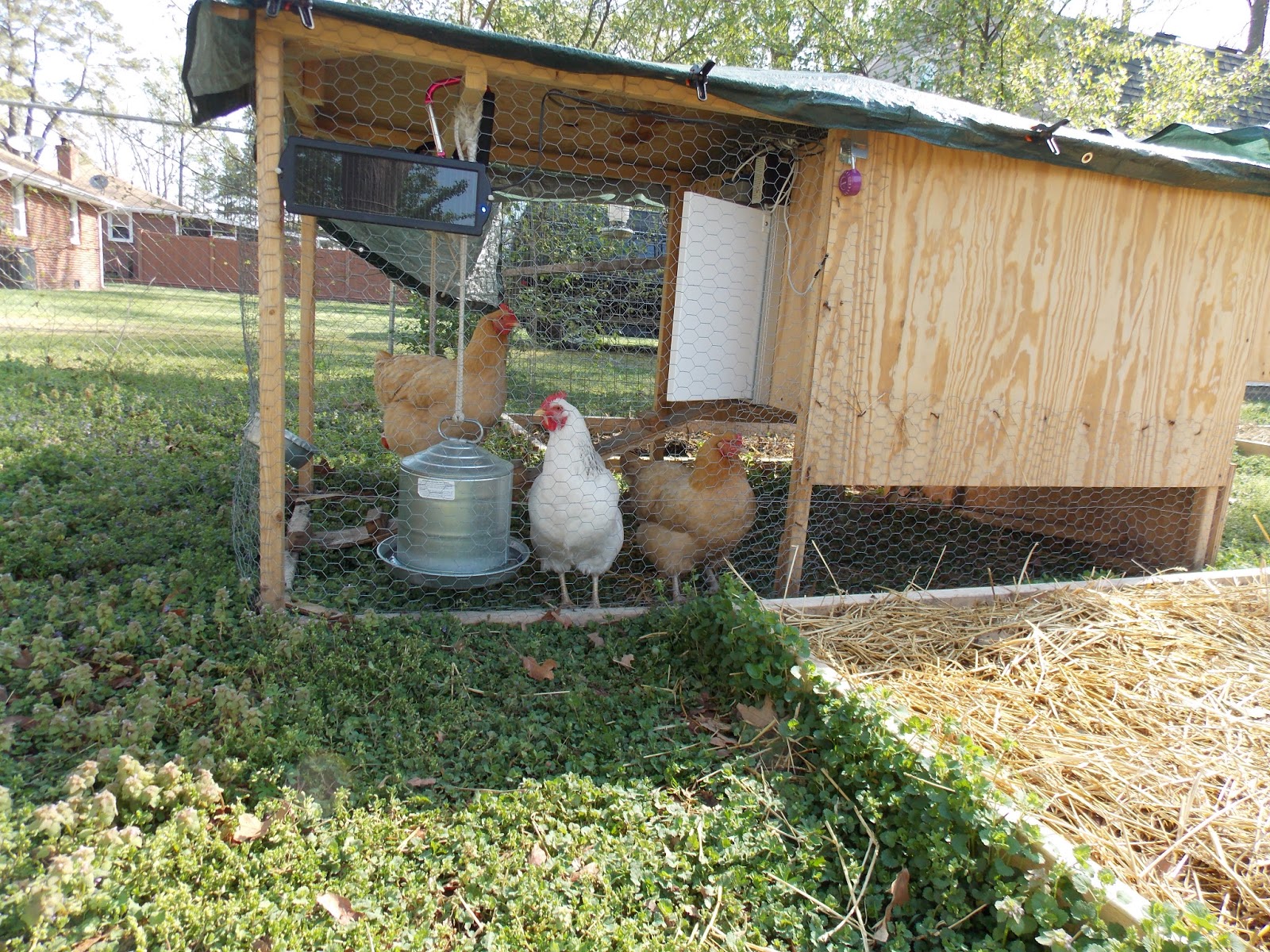
If you don't believe me, that's understandable. Folks picture chickens as dirty, smelly birds that burn the soil. But we are "urban chicksters," and our hens are kept in a portable coop and pen, also called a chicken tractor, that we move around the yard. By moving the pen frequently, we prevent the chickens from burning the soil and scratching and eating it bare. Instead they weed, graze, and slightly fertilize an area before we move them onto new ground.

This spring we had some lawnmower trouble and let the backyard go a little too long before the first mow. Our backyard is also fenced to separate the chicken/garden section from the dogs' run. Check out the differences in these sections of our yard as shown in the following pictures. I snapped them right before tackling the lawn with the mower. Keep in mind that NONE of this lawn has been mowed so far this year:

This is the area that has regularly been visited by the hens and intensively grazed due to the chicken tractor

Don't know what I mean by a chicken tractor? Here are three of our girls saying hello!

The other two are working a compost pile/future garden from a pen attached to the tractor. Where there's no lawn, there's lots of high-carbon organic matter!

Here's an area of the lawn that gets occasional visits by the chickens but is too uneven for the tractor

Here's the same lawn where the chickens never go. The paths have been worn by our three dogs. What a difference!

Interested in seeing some hens up close and personal? Visit us during the Chesapeake Tour de Coop, held next Sunday (April 21, 2013, from Noon to 5 PM, weather permitting).

Saturday, March 23, 2013

First Chicken Swap

I went to my first chicken swap today. Actually, to my first two chicken swaps. The first was in Franklin, Virginia, at the Tractor Supply Company (TSC) there. The other was at Epps Farm Supply in nearby Suffolk, VA. I had a hankering for two new hens. I wound up with two new Rhode Island Red pullets and a young Beagle.

Lucky for me, my husband, Don, has a soft spot for Beagles!

If you found this post because you are looking for regional chicken swaps, try Pet Chickens of Virginia. I posted a link to its website but it's also on Facebook, which seems more user-friendly. Also check at local feed stores.

For the uninitiated, a chicken swap is an informal event, usually at a farm-supply or feed store, where folks gather to buy and sell poultry, small animals, and other related items. I was eager to augment my micro-flock of three backyard hens, one Delaware and two Buff Orpingtons, with two egg-layers of a different breed. I wasn't sure what I wanted, but I wanted young hens that were laying or pullets that were close to laying. I wanted clean, healthy-looking birds. And I didn't want to go to the time and trouble of hatching and raising chicks.

The monthly chicken swap at the TSC in Franklin has the reputation of being one of the biggest and best-attended around our region, so I set my alarm early and headed over with anticipation. It was fun to see the variety of animals for sale there: goats, turkeys, ducks and ducklings, chicks and chickens, and rabbits. There were also some interesting-looking perches for chickens and even a model chicken-tractor.

It was still early in the morning at TSC, but the vendors were out and so was the crowd of shoppers

This Tom turkey looks as curious about me as I am about him!

Polish roosters looking like rock stars behind bars.

Another view of the Polish roosters. Phyllis Diller would be proud!

A kid (baby pygmy goat) crying for its mother

This is either a model chicken tractor or a design for some really small bantams!

The same builder makes perches for various sizes of chickens.

While the shopping there was interesting, I left empty handed other than for some garden seeds I'd bought from TSC. A few of the birds were dirty and unkempt-looking. Most of the hens there were old, past their prime, and probably destined for someone's soup pot. There were three juvenile pullets that caught my eye, but they were Buff Orpingtons, the breed I already have. Most of the chickens were roosters or straight-run chicks.

Straight-run means they are not sexed. Besides not wanting to raise chicks, I especially needed to avoid straight run babies, because I live in a residential area where only hens (female chickens) are allowed. This is because hens are generally more docile than roosters. They are also much quieter.

I drove about 25 minutes from the TSC to Epps Farm Supply in Suffolk. My GPS took me on a pleasant, windy, back-country route that was fun driving on such a pleasant morning.


There were fewer vendors set up at the second chicken swap, but fewer customers, too. And I met a nice young woman who had two young, female, Rhode Island Red chickens for sale plus a cute bantam rooster. They were in a large wooden box on the ground behind the tailgate of her truck. On the back of the truck in a crate she also had a small beagle that was looking around and shaking uncontrollably.

I found my pullets and something more!

She told me the pullets, female chickens that have not yet laid, were old enough to be on layer feed. They should start to lay in about a month, and they were $15.00 each.

Sold!

"And do you happen to need a dog? He's FREE!" she added when I accepted the terms.

I eyed the dog, still shaking in his crate. "My husband has a soft spot for Beagles. What's his story?" I asked.

She told me something about finding the dog at a local dump, where the dog seemed to have also been dumped. He'd been scavenging for food. She'd been feeding him some kibble regularly, but subsequently found him near her house. Her family's lab bitch had come into season, and that will draw males from miles around, including this guy.

"If I take this dog home," she said, "my mama will kill me! And if he hangs around our property, sniffing around and trying to get to our Labrador, my daddy will shoot him." Her look was earnest.

Don and I had recently lost a dog. I called him and asked if he were willing to rescue a Beagle I'd found. OK, I fudged a little on that part, but not by much.

"Let's try him out," was my loving man's reply. I smiled.

You, Loyal Readers, will know the truth. So does Don, now that I have this dog safely home. If anyone else asks, though, I'm going to say that the farmer's daughter got such a good deal from me on her two pullets, she threw in a free Beagle!

In case you're wondering whether he found a good home, he'll be getting Blue Buffalo premium brand dog food, a choice of Kuranda beds to sleep on, a doggy door and fenced in yard to relieve himself and get fresh air at will, a doggy seat belt in the car, walks, romps in the woods with Don, you name it...

Yeah, we spoil our chickens, too!

He'll be going to Dr. Virginia Vaughan at Veterinary Clinic of Chesapeake sometime this week for a checkup, shots, and an appointment to get neutered.

So here they are, our current menagerie, except for our house cat. So far the Beagle is getting along with everyone. We haven't named him yet, so suggestions are welcome.

Our two Rhode Island Reds in quarantine

Here's our rescued beagle. He stopped shaking around the time we put him in my car

Our new Beagle with our elderly Labrador mix

Our new Beagle with our Treeing Walker Coonhound

Athena, our Delaware hen, is the queen of the flock and rather put out by the pullets' presence

Our two Buff Orpingtons, Minerva and Nike, seem curious about the new chickens
Our beagle boy has one last thing to say to the folks who dumped him to fend for himself!

Monday, February 25, 2013

Hens as Compost Turners in the Garden

Don and I need more garden beds. But we spent time, money, and a lot of muscle building the four raised beds that we started with, so we thought we would build our next four beds the lazy man's way, using a method called sheet mulching or the lasagna layer technique. It's a way to compost in place to build up soil for a new bed instead of digging down to get your garden. The biggest drawback is that you have to wait a season or so before planting.

Don and I recently set up some lasagna-layer beds, but I admit they didn't look like much. They looked like they'd take years to break down into something I'd be willing to plant vegetables in. Here is a picture of what we were starting with. It contains layers of cardboard, leaves, somewhat aged compost, and straw mixed with a week's worth of manure from our chicken coops:

Sheet-mulched raised beds before attention from our hens

Don and I know how much our girls love to scratch and forage for insects, seeds, and other food, so we wondered if we could use those skills to turn these beds and get the composting process going faster. Don built a pen that fit over our raised beds. There's a pop-hole that leads from our chicken tractor to the pen over the beds, as pictured and described in this post. We had already used the hens in this pen as herbiciders and pesticiders in our raised asparagus beds, but we wanted to see what they would do when we turned them loose on our future garden beds as well.

The first thing we noticed was that the new digs were a huge hit with the hens. They even ate about 50% less feed when on a fresh sheet-mulched bed, presumably from all the fresh food they find on their own. Here is a brief video of our girls having a good time working a bed this morning. It's the same bed I pictured at the top of this page, but it already is starting to look different due to the hen's attention.


Here is what the same bed looked like at the end of the day today:

Nike is pecking at something good in the compost pile!

Sharp-eyed Athena is begging for a treat-- got any meal worms?

After about three days of attention from the girls, the bed starts to lose the girls' interest, and they start eating a lot more feed. Perhaps they've found all the weed-seeds and bugs that they're going to for a while. They will be ready for us to move their tractor and pen to another bed or a different part of the yard. But this is what the bed will look like after just those three days:

Raised bed after three days of chicken-tilling efforts

There is no doubt about it: the chickens are speeding the decomposition process and composting our sheet-mulched beds into usable soil faster. They basically turn other people's garbage into the raw materials of a vegetable garden. And they do it without the noise, pollution, or expense of gas-powered tillers or other equipment. They literally work for chicken feed, and they are happy about it, and they add valuable nitrogen to the bed in the form of their own manure while they're at it!

One important decision we have left is how soon to plant after the chickens have turned the bed. Since they have deposited fresh droppings, and their manure can transmit salmonella, published advice is to wait for 90 to 180 days after the chickens have visited the bed to plant a food crop, depending on the crop. But we needed to wait at least that long before planting under the sheet-mulch system, anyway, so we have little to lose, and lots to gain, by having the chickens work the beds for us.

**Update on 1/18/14: We have been using those sheet-mulched beds to grow garlic, and I now have a fig tree growing very happily in one. I cannot believe how quickly the beds broke down into something usable and very fertile. I think the hens' manure and aerating-skills were a huge part of the success.

Wednesday, February 20, 2013

Automatic Chicken Coop Door

Automatic Pop-Hole Door for Our Coop
We got one of these doors for our coop:

http://www.chickendoors.com/products.htm

It was an easy install, with only four screws used to mount the frame of the door to the coop.

We got the door with the light sensor so that we don't have to worry about programming, although we can program the door to specific times if we wish.  It can also be opened by manually actuating the motor.

This door has a "Last Chance" function which reopens the door for about ten seconds about one minute after the evening closing.  That gives any hens that dally a chance to get in.

I picked up a battery at Batteries Plus, fabricated a battery bracket from some fencing, and had it up and running in a few minutes.

So far, it has been flawless.

Sunday, February 17, 2013

New to Backyard Chickens? What I Wish I'd Said...

4 Chesapeake Hens and Hampton Road Hens appeared at the Chesapeake Central Library last night. The library staff were surprised by how many people showed up! Many of them were adults looking for more information about backyard chicken-keeping. Families were supposed to preregister, but a front-page article in the Chesapeake Clipper hadn't mentioned that fact, so folks just showed up. The librarians were gracious about it, though, and managed to find a room big enough to hold us all.


Standing Room Only Just for the Adults! The Youngsters Got to Ask Questions, Pet a Chicken, and Go to Storytime
 Our time with the youngsters took about twenty minutes of our scheduled hour, and then the rest of the time turned into a question-and-answer and information sharing-session with the adults. It went well, and we talked up many of the great aspects of having backyard hens. But I wish I'd had time to answer some of the inquiries at greater length, and to warn folks of some potential problems to avoid.


Our Intrepid Team of Presenters Sport Our Hampton Roads' Hens New T-Shirts!
1. We told folks to read up. There is great information online. Hopefully participants picked up flyers that the library had printed up for us that had further resources. We also directed them to books that the library had available. My personal favorite book is City Chicks by Patricia Foreman. Backyard Poultry Magazine and Mother Earth News are great resources, too. Good websites are backyardchickens.com and a popular blog called "Fresh Eggs Daily." But here are some additional ideas or precautions I would have shared if given enough time:

2. Be sure you are getting hens. Roosters are illegal here in Chesapeake in residential areas. There are three ways to be sure you are getting hens:
  • get sex-linked hybrids if you are getting chicks. There is no mistaking the sex of the chick because the boys and girls have different coloration upon hatching;
  • get your chicks from a reputable hatchery and order hens only, but realize these hatcheries have *at best* a 98% rate of accuracy at sexing chicks, so plan out what you will do in case you get an unexpected rooster;
  • skip the chicks and get pullets or grown hens. These will be easier to start with than chicks are, anyway. Pullets are hens that are just about to lay or just starting to lay. You will get your eggs that much faster, and even though they cost more up front, they require less in terms of specialized equipment, feed, and care. You will also get your eggs faster. The downside is that you miss the fuzzy cuteness of chicks, and your birds might not be as tame or used to being handled as you would like.
  • if you decide to hatch your own chicks from eggs, read up on this process carefully, and decide what to do with the roosters that *will* turn up, because there's no way to sex eggs. 
  • DO NOT BUY "straight-run" CHICKS. This means these chicks are not sexed and will contain a large percentage of roosters;
  • deciding what to do with the roosters does *not* mean turning them loose, since they can't fend for themselves, nor does it mean keeping them, which will be noisy, illegal, and possibly dangerous if the birds are mean. Nor does it mean hoping for a farmer out in the country who will want them to raise and not to eat. Line someone up in advance, because it's not that easy.
  • While finding roosters a good, last-minute home sounds good, it's unlikely. Realize that unwanted roosters often become people's meals. Also, remember that slaughtering the birds is illegal in residential areas, so if you decide to slaughter and eat them, be sure to know how to do this humanely and where to do this legally. (And only eat healthy birds, not sick or diseased ones).
3. Chicks need specialized care: extra protection from drafts and predators, the correct levels of warmth, and specialized feeders and watering equipment. Again, read up on raising chicks before you do so.

4. Regarding coops, we mentioned a variety of websites and plans available online, and that coops can even be purchased online, but we should have taken time to go into more detail about basic coop requirements besides fresh feed and fresh water daily, including fresh water in winter, when water tends to freeze. Here are other ideas:
  • For optimal mental and physical health, be sure your birds have enough room. Here is a summary of my own research on this topic.
  • Your birds will be happier if they have perches to roost on. Be sure they are free of splinters, which can cause bumble foot.
  • Be sure your coop is dry, ventilated yet not drafty, and sturdy enough to provide protection from vermin and predators. This includes rats (at night, when the chickens can't see), possums, hawks, owls, raccoons, weasels, dogs, and any other creature that likes chicken because they "taste like chicken." Books and online resources have lots of advice on how to protect your flock. Harvey Ussery's book, The Small-Scale Poultry Flock has some great suggestions. A pop-hole with a sturdy cover that locks up tight at night and hardware cloth across any openings, even small ones, should be standard on your coop. Chicken wire is meant to keep chickens *in,* not predators *out.* Dogs and foxes will dig under fencing and your coop, so plan for that, too, when you are thinking about protection.
5. If you plan to keep your birds as pets, line up a good avian veterinarian before you need one. I recommend Dr. Poutous at Midway Veterinary in Chesapeake. Even if you consider your birds livestock, you will need to read up on how to keep them well fed and healthy, how to administer basic medications such as de-wormers, and how to prevent and treat common diseases. If you wish to keep them healthy and not pay for veterinary services, you'll need to know how to do more yourself. Lining up an experienced local chicken-keeper as a mentor is a great idea!

6. If you have young children or family members with compromised immune systems, realize that hens can harbor and shed some diseases, most notably salmonella, while showing no symptoms. Supervision of young children, gloves and hand-washing, and other common-sense precautions should be followed. This is especially true of handling chicks, which tend to shed salmonella more than grown birds. All birds will shed the virus when stressed, however. Gail Damerow's Chicken Health Handbook has loads of information about chicken care. Harvey Ussery's and Pat Foreman's books have suggestions, too.

7. I almost forgot! Be a good neighbor, and make sure you only feed your hens what they'll eat during the day. At night, pick up any uneaten food. Store scratch and feed in vermin-proof containers, such as in a heavy metal trash can with a bungee-cord on top. Mice and rats are not naturally attracted to chickens, but they can be attracted to leftover feed, to food scraps lying around, and to the warmth and darkness of a coop. They can also slip through very tiny holes. And rats will sometimes attack chickens at night. The hens can't defend themselves because they are night-blind. Be a good friend to your neighbors as well as to your hens, and keep the place clean (updated 5:31 PM).

If you're an experienced flockster and  notice that I forgot anything basic and important for beginners, please post a comment for our readership. Thanks!

**Update on 4/15/13: We DID say this at the meeting, but this bears repeating: there is a three to five foot setback from the coop to the property line. Be sure to be a good neighbor and implement the setback. The hens must also be kept in the backyard.

Saturday, February 16, 2013

Gardening with Chickens

Clover sprouts are nutritious and a big hit with our hens

Now that the excitement of our first egg has settled down, Don and I are enjoying the benefit of having our chickens help us with our gardening chores. Don has built a portable pen that fits over our raised vegetable beds. Two of the beds were mostly bare, just mulched with leaves in preparation for the spring season.

Our chicken tractor links up to a raised asparagus bed in winter

Don built a pop-hole on the coop and a pop-hole in the pen over the raised bed. Then he built a narrow wooden tunnel to connect the two pop-holes. The pop-hole to the coop has a wooden cover that fits tightly at night to deter potential predators. But during the day, the chickens get more room to range, quite legally because the law requires we keep them penned. The pen also keeps them out of my winter vegetables growing undisturbed in nearby beds. Most importantly, it protects my hens from hawks that might attack them from above. We have a sturdy chain link fence around the yard, but we need to protect our birds from raptors.

The same coop viewed from the rear. Note the attached nest box.


The cover for the pop-hole to the pen

My girls have deposited some of their valuable, high-nitrogen manure in these beds, which will be much appreciated by my asparagus plants, which are heavy feeders. They've certainly found all kinds of bugs and weed seeds. I am hoping they have found any asparagus beetles and their larvae that might be overwintering in these beds. I'd like these pests to be converted to nutritious eggs while reducing my feed bills, not hatching in the spring to feed on my asparagus!

The chickens have also spread some vermicompost from our worm bins all over the bed. All we had to do was pick out the worms that we wanted to save from their voracious appetites, dump the compost in the middle of the bed, and spread a little scratch on top to encourage the girls to scratch.


The hens are checking out their new digs

A hen inpects the tunnel to her coop; pop hole visible at the rear


The girls LOVE clover! There was no trace by day's end