Showing posts with label tomato gardening. Show all posts

Friday, July 6, 2012

Potted Herbs Beside the House

Thyme
We grow potted plants along a sunny wall outside our house. I probably will move the herbs to the main garden behind the house eventually. For now, it is very convenient to have them within easy reach of the kitchen, since several of the plants are herbs. We grow thyme, oregano, parsley, a little lettuce, tomatoes, and flowers. The tomatoes are from the "Little Tomato That Could," a plant that came up last fall. We nurtured it all winter long.

The mixture of herbs, tomatoes, and flowers attracts beneficial insects and predators to the garden. We haven't had problems with insect pests in this corner of the garden all summer.

Lettuce and Oregano

The Little Tomato That Could
One of the logs from a tree Don recently trimmed to give my vegetable-gardens more sun is quite pretty. I asked him to cut the log in such a way that I can move it to my garden and use it as a planter. I am thinking I will put some soil in the hollowed-out area and plant shallow-rooted crops like lettuce in the fall. It will be decorative and a little useful.
Marigolds Attract Beneficials

Carrots

Potential Container for Lettuces

Another View

Thursday, June 7, 2012

First Tomato This Year

Our Winter Tomato Bears Fruit

 We harvested our first tomato from "Little Tomato That Could" this year. By this I mean the tomato plant that came up as a volunteer in one of my planters last fall. My husband, Don, refused to let me pull it up. He and I nurtured it all winter, and today it has borne us a big, edible-looking fruit. I was worried about a spot at the bottom of it turning into blossom end rot, but whatever the blemish is, it looks like it is just a little spot that can be trimmed off. Don loves tomatoes and will have the honor of the first bite. I hope it tastes good after such a long effort on all our parts!


The Little Tomato Last Fall
The close-up picture of the fruit at the top was taken with my new Canon PowerShot A1300 point-and-shoot digital camera. My beloved Nikon P60, the one I had toted all over Italy and all through my honeymoon, finally gave out on me. So far I am quite pleased with the new camera and the quality of the pictures it takes. It has a faster flash and takes more reliable pictures in dimly-lit rooms than my Nikon did. The older Nikon would take great pictures, but sometimes I had to fiddle a lot with the settings to get what I wanted. The new camera is a true point and shoot. Light, easy, and reliable.

Sunday, May 27, 2012

My Virginia Garden Late May 2012

Square-Foot Raised Beds, May 27, 2012, Southeastern VA

My raised beds are doing better than I ever dreamed. If you want to see what I have planted where, my online garden planner has more details. The asparagus is coming up beautifully, and the beds are coming alive and green with vegetation.

Asparagus Bed
 The beds are mostly vegetables but I interspersed flowers to attract pollinators and other beneficial insects. I've put some flowering potted plants near the beds for the same reason. I've already started to harvest some Cherry Belle radishes, both the greens for salads and the roots themselves. The Romaine lettuce is ready for some selective picking of their outer leaves. I've mulched most plants, except the lettuces, since mulch attracts slugs. Most plants have been mulched with a mix of chicken manure, vegetable scraps, straw, and other items from my Compostumbler, but some of the squares of asparagus with white clover. The clover is an experiment. I suspect it is a bad idea, especially since it is the first year for the asparagus. I read in an article that researchers tried this and the asparagus produced thinner spears than the control plants and reduced yields:

 Unsuppressed white Dutch clover established
at asparagus planting controlled weeds and provided
N over time to the asparagus in a Wisconsin
study, but reduced yield significantly. Establishing
the clover in the second year or third year of an
asparagus planting would be more effective.
Experimental asparagus with clover as living mulch

Unfortunately, I sowed the clover with the asparagus in the first year. Everything I've read suggests that Dutch White Clover is a good idea under tomatoes and pole beans, although it does compete with the taller plants for water. Water has been plentiful so far this year so I will allow the experiment to continue. ***Update or 7/18/12: The asparagus has grown in so thick, it has smothered most of the clover for lack of light. I suspect this is just as well. The clover adds nitrogen to the soil, and if it's dead, it can't compete with the asparagus for water in the summer heat we are having. I was afraid the clover would take over my vegetable beds, but it never did.

I read somewhere a recommendation of sowing winter peas and oats in late September over cleaned asparagus beds as a winter cover crop. The Sustainable Agriculture Network recommends winter rye for the same purpose in its free publication, "Managing Cover Crops Profitably."


Squash Bed
Something, either slugs or caterpillars, has been munching heavily on my radish tops. I plan to try some beer traps in case it is the former. The radishes may be acting as a trap crop, however, because whatever the pest is, it has been mostly leaving my young spinach and lettuces alone. I'd much prefer to lose radish greens than the other salad greens. I also tried spraying a little Neem oil on the radishes and on the few lettuces that are seeing damage.
Romaine lettuce

Basil with leaf mulch

Basil with compost

Baby spinach
We have lot of trees on our property. This has both its good and bad points. The main bad point is that we accidentally located the garden in a spot that does not get enough sunlight for fruiting crops such as tomatoes. To give ourselves credit, there are so many trees it is hard to find a truly sunny spot. Don plans to trim trees and limbs to improve the sunlight. He can't do it fast enough for me!


The "up" side to having so many limbs is that they produce lots of leaves. Our oak tree also sheds flowers in the spring (and tons of acorns for the squirrels). Yes, the leaves are a plus! We continually shake our heads at neighbors who bag them up and leave them at the curb.

We have a terrific lawnmower. We can either use it as a mulching mower, and mulch DRY leaves and oak flowers into the soil, or we can use the bagger that comes with the mower to shred the leaves to use as mulch. Right now most of my garden is mulched with compost  or leaves or a combination of both.


Two words of warning: be sure the leaves are brown (dry). Be sure compost is well-aged. Squash and potatoes, however, will grow more easily in less-than-optimal compost than other plants.

So far I love pole beans! This is the first year I've ever grown them, and I love how quickly they grow up the teepee-style trellises I have put up for them. But I wouldn't have planted them so close to the tomatoes if I'd realized how little sunlight my gardens would get. Oh, well.

Tomato, Pepper, and Pole Bean Bed
  Note to self: I have GOT to pay more attention to my garden planner. I originally planned to grow two tomatillos. I think I read they pollinate and produce better that way. I had two growing beautifully. Wouldn't you know it, I pulled one up? Aargh! At least I'll have more room for squash, since I am growing more than I originally planned in the same space. The square-foot method isn't well suited to squashes, melons, etc., although you can try growing them vertically, which is what I plan to do.

I will post some pictures of my flowers planted for biodiversity and attracting pollinators below. Some double as edibles or herbs.
Nasturtiums are spicy and edible

Marigolds are welcome in any garden

Forget Me Nots

Potted Thyme and Cilantro Flowering

The Little Tomato That Could, End of May

The Little Tomato's first fruit


It's been a month since I've updated my posts on the "Little Tomato That Could." This is a little plant that came up as a volunteer in one of my outdoor pots in November of 2011. Don Burke, my then-fiance, now husband, likes to rescue forlorn-looking creatures, and I've rarely seen a plant that looks as pathetic as that poor tomato did last fall. He stopped me from pulling it up. He nurtured it all fall and winter with reluctant help from me. The plant has gotten a little brittle, and the last time Don moved it, about half of it broke and fell off. Ever the optimist, Don took one of the broken vines and stuck it in some dirt in another pot. That part is still alive, but I'm not sure for how long.

The original "Little Tomato" has bounced back from the rough handling. It is even producing one early and large tomato, which is in that green-turning-yellow stage that tomatoes reach as they begin to ripen. I hope it turns red and that it avoids blossom end rot. The moisture content has been hard to manage in the pot that Don has been growing the plant in, especially with our summer weather so hot and dry. I don't have high hopes for it. I already see a little sunken area in the green tomato that looks like the beginning of the problem.

The Little Tomato That Could
The Little Tomato last fall

Saturday, April 21, 2012

The Little Tomato That Could, End of April

The Little Tomato is starting to produce fruit. The plant that my husband rescued back in November and that we have nurtured through the winter is now producing flowers and tiny green tomatoes. We were wondering if it would bear fruit at all, since it's of uncertain and probably hybrid parentage. Don is one proud papa, and I don't blame him!

Little Tomato Today
Have I ever mentioned that Don eats tomatoes (apples, too) like nobody I've ever known? I hope these tomatoes mature into something wonderful to reward him for all his efforts.

It looks healthy, although it's not the handsomest tomato I've ever seen. It's certainly a far cry from the pathetic Fall seedling pictured below.
Little Tomato in November

Tuesday, March 27, 2012

The Little Tomato That Could, End of March

It is now the end of March, and here is how "The Little Tomato That Could" looked last weekend.

For those readers new to my blog, this tomato came up in our Southeastern Virginia garden last November, and we have been raising it as one of our "rescues" through the winter.

It seems to be recovering nicely from the burns it got from growing too close to the fluorescent bulb Don had put in its winter trash-can growing space. It really likes the outdoors and the sunshine it is getting on the garage side of our house. We put it up against a brick wall to give it a little extra shelter and heat at night, too. It is even trying to flower. We really didn't harden it off, but that doesn't seem to have hurt the tough little plant.
flower buds

I must admit I was pretty skeptical when Don declared last November he was going to try to save it. Now I am hoping this seedling of unknown heritage will produce some decent fruit. If so, we'll definitely have the earliest tomatoes in our neighborhood!

The weather has turned cool both last night and tonight, so we've brought the tomato inside for safekeeping. It will go back out tomorrow, though, when the high is supposed to be back up in the 70s and lows in the 60s at night.
more flower buds

Tuesday, March 6, 2012

The "Little Tomato That Could" Early March Update


The "Little Tomato That Could" is still growing in our bedroom and getting to be a good size. In fact, it's outgrowing the garbage can that it lives in. Like Oscar the Grouch on Sesame Street it wants to pop the lid right up and peer out at the world. It has burned some of its leaves by getting too close to its fluorescent bulb light-source. Don needs to raise the bulb up again to give the tomato more room. I'm starting to think less about "if" it lives and thinking about "when" it is ready to harden off and move outdoors. Tomatoes can go outdoors around here towards the end of April, less than two months away.


I was planning to find some space for the tomato in our vegetable beds this summer, but Don wants to raise this particular tomato from a hanging basket. He is very protective of his project and wants to finish raising it himself. The squash Don rescued from our kitchen compost bin isn't doing as well. It is looking sickly, and I don't think it will make it until spring.


Sunday, March 4, 2012

Bluebirds of Happiness


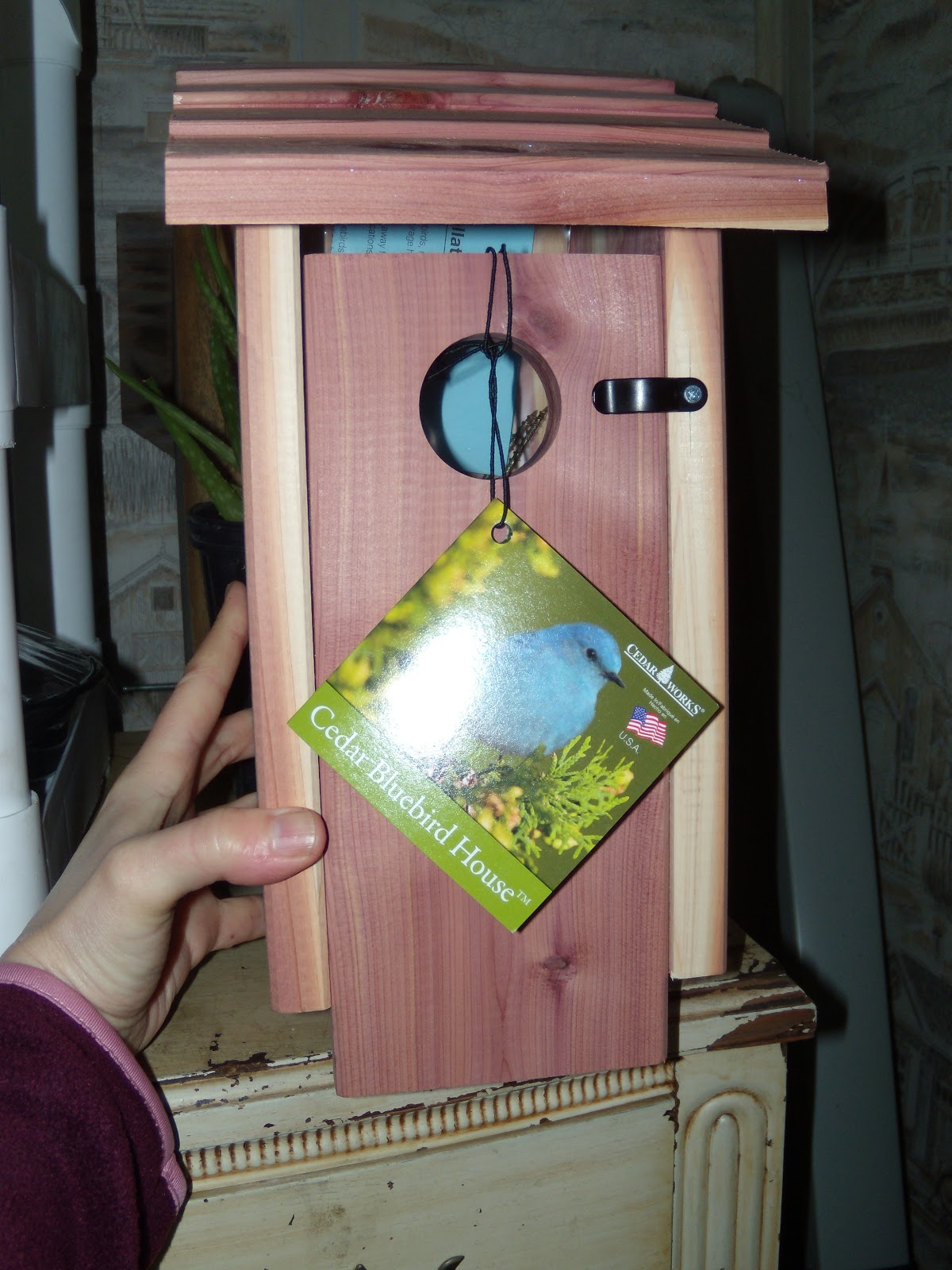
 Here is a picture of the beautiful bluebird house I bought recently. I already own one. Which is why I need two:


My past experience has been that house sparrows are more likely to move into the house than bluebirds. But I want bluebirds there. Not only are they beautiful, but they eat all kinds of bugs, which is why I want to locate the houses near my new gardens. What aspiring organic gardener couldn't use a little feathered help keeping pests out of her garden? Besides, house sparrows are thriving everywhere, whereas bluebirds seem to need some human help with their housing.

Eastern Bluebird

A little research has turned up the fact that if we put two (or more) bluebird nest boxes 5 to 15 feet apart, the sparrows will nest in one and the bluebirds in the other. Both birds are territorial, you see, and won't nest close to others of their kind. So we are going to give two nest-boxes a try this summer. We are a little late getting the boxes up, however, since the website says that they start looking for suitable nesting sites in February in the South.

House Sparrow


I was overjoyed today to see my first tomato seedlings sprouting on my kitchen counter. I have four: 1 Big Beef Hybrid, 1 Heirloom Italian, 1 Brandywine, and 1 Experimental Hybrid from Shumway. I look at these tiny, delicate little vines reaching toward the available light, and my mouth waters for the taste of home-grown tomatoes this summer. I hope some other vines sprout in the next few days, because these four little plants can't possibly be enough!

Sunday, January 29, 2012

The "Little Tomato That Could" Again

I should preface my update on "The Little Tomato" with the fact that my fiance and I have three dogs and one cat, and all of them are rescues. This means that nobody else wanted them, and by taking them in, we probably saved their lives. The three dogs came from the SPCA of Northeastern North Carolina, and the cat from a total stranger on the Freecycle Network.

But my fiance has more sympathy for and patience with the underdog than even I do. This year I found a pathetic tomato plant that was sprouting in my fall garden. He wouldn't let me pull it up but has nurtured it. We've had unseasonably warm weather in Southeastern Virginia this year, and the plant was in a container along the North wall of the house, and we'd covered it with a cloche, but we finally had a cold snap about two weeks ago where he had to bring the tomato plant inside the house or lose it to a killing frost.

But I am a worrywart. And I knew that the tomato couldn't live in our dimly-lit living room. I watched the weather forecasts carefully, and when the days were supposed to be relatively warm and sunny, I'd been putting the tomato out on the front lawn to feed on the energy of the sun.

So, there we were, with me lugging the heavy planter onto the front lawn every day and my fiance lugging it back in each afternoon or evening as the temperatures started to drop. But the tomato was unhappy. It was exposed to winter winds, had insufficient light despite our efforts, and was looking increasingly poor.

So Don converted an old garbage can into a house for the tomato. He put a light in the lid and put the light on a timer. He put the tomato plant in its new home in a corner of our bedroom. Then he found a squash plant that had sprouted in the moist darkness of our worm composting-bin and decided to rescue THAT. So now we have a baby squash plant keeping the tomato company. And something else is coming up in the planter; Lord knows what! The plants get 14 hours of compact-fluorescent light a day. A regular plant light would be better, from what I've read, because it gives a broader spectrum of the lights plants need. The fluorescent tends to make plants grow leggy. But we'll have to risk it, because Don likes to conserve energy.

I'll post some pictures below of the tomato plant and its new companions. So far they are looking healthy, and the tomato has certainly turned quite green. The worrywart in me worries that the plants might need better air circulation.  And if Don finds any more plants he wants to rescue, he's going to have to build us a greenhouse!


Thursday, December 29, 2011

The Little Tomato That Could

Yesterday we checked up on "The Little Tomato That Could" again. It seems not to know its seasons very well and started coming up in the fall. At my fiance's insistence, we have been nurturing the little thing now and then, when we think of it, to see how it will grow and how long it will live. While I cannot report that the tomato is going strong, I CAN report that the tomato is still going. The cloche has been a big help since the night temperatures here have occasionally dropped below freezing. The tomato is up against a wall, and we have a jar of water sitting next to it. Since it is in a sunny location, the thermal mass helps. I suspect it would be growing even better if we paid it better attention than we do. We did bury its stem deeper when it started to show its first true leaves to encourage growth in its root structure. Here are a couple of pictures, taken December 28, 2011.


Here are pictures of the cloche, from my November 16 post:

I should also report that our Corno di Toro pepper plant is still producing peppers, although the plant itself is looking quite yellow and very sorry for itself. If the peppers grow, by some miracle, into a ripened state, we will save some seeds, because this plant has been an amazing producer under extreme hot and cold conditions.

Update on January 6, 2012: I am sad to report that our pepper plant has succumbed to the hard frost we had earlier this week. We will have to pull it up and compost it. The "Little Tomato That Could" is still alive, because we brought it inside for a couple of days. I have put it back outside under its cloche to help it get enough sun, now that the weather has warmed back up, but will have to watch the weather reports carefully.