Saturday, June 30, 2012

Garden Update Late June, 2012: The Squashes

Baby butternut squash
The butternut squash is starting to come  in. I like butternut for a lot of reasons, mostly related to taste. If you pick them young, while they are still yellow, they taste and cook like summer squash.

I have plenty of summer squash coming in, though, so I am going to wait and let these ripen up. If you pick them when they are completely ripe, and are careful not to bruise them, and if you store them properly, they will keep quite well through the winter months. That's why these are called a kind of winter squash.

Summer Squash (Tomatillos to the Left)
So far I have seen no sign of the squash bugs that plagued my garden last summer. I suspect the main reason for this is that I have avoided using wood chips for mulch underneath them. Squash bugs really like to hide underneath wood! I do have wood chips on my garden paths, however. Don and Matthew chipped up the tree limbs that were destroyed, along with part of a neighbor's fence, when he promised me the sun. I am also experimenting with growing the squash up on a trellis to make any squash bugs easier to see and, hopefully, more vulnerable to predators. I've learned to squish them when I see them, however, especially the nymphs, which move a lot more slowly than adults.

To trellis the heavier squashes is not enough. I will have to find the baby squashes and support them up against the trellis as they grow. This is new to me, although I've read about it and seen it done in my travels in Italy.

Thursday, June 28, 2012

2nd Letter from a Chicken Activist

I started a Facebook page called "4 Chesapeake Hens." Its fans have been working to change the zoning laws in Chesapeake, Virginia. Currently, property must be zoned agricultural or be a "residential estate" of three acres or more to keep laying hens. Our group wants the city to allow up to six laying hens to be kept in most residential areas. We have even started an online petition that readers can sign.

Our most recent campaign has been "City Council Member of the Week." Each week our group chooses one member of City Council and asks our fan base to make contact to politely explain why we wish to keep hens. I have been emailing our City Council Members and getting no responses at all. So I thought I'd also post my emails here for all to read. Here is my email to our second member, Suzy Kelly:

Dear Suzy Kelly,

I am a resident and voter in Chesapeake and a founding member of the local grassroots community group, "4 Chesapeake Hens." I am writing to let you know how much it would mean to me and my family if zoning rules were changed to allow more single-family residences to have 2-6 laying hens, as outlined in our petition which you may read at  http://www.change.org/petitions/4chesapeakehens#. The petition has gathered over 390 signatures as I type this, and we have been gathering more out in the community at large.

My husband, Don Burke, and I live in a quiet, established community just off of Battlefield Blvd on H...... Drive. We just married in April, 2012. Originally, Don was going to sell his place and live with me in Elizabeth City. But I found work as a teacher in the Chesapeake Public Schools and moved here when Don, a retired Navy submariner, had trouble finding work in Northeastern N.C.

I am a vegetarian and an avid gardener. I started vegetable gardening in Elizabeth City when I was newly divorced, with no extra cash, and gas climbed to $4.00 per gallon. I had to think twice about spending the money to make trips to the local Walmart, so I bought seeds and started gardening at home. My clay soil was terrible for growing anything, so I got into composting to make my own, inexpensive amendments for improving the soil on my lot. Even though the lot was much smaller than where we live here, nobody ever complained about any smell, because we composted responsibly and there was minimal odor to complain about.

Don and I found that chicken manure was one of the best sources of nitrogen and other nutrients for my vegetables. I was regularly purchasing fresh, local eggs from a friend, and picking up manure as well as eggs there became a regular part of our routine. I buy local eggs not only to support the local economy but because I am concerned about the environment, nutrition, and animal welfare. The treatment of laying hens in the mass-produced conditions that produce those cheap, nutritionally-inferior eggs we can all buy cheaply at Walmart and the supermarket is abysmal. Visit the Humane Society of the United States if you need more information: http://www.humanesociety.org/issues/confinement_farm/facts/battery_cages.html.

For information on the nutritional superiority of pasture-raised eggs, read this widely-quoted article from Mother Earth News: http://www.motherearthnews.com/Real-Food/2007-10-01/Tests-Reveal-Healthier-Eggs.aspx.
The nutritional value is important to me as a vegetarian, since eggs and very occasional dairy are my only sources of animal-based protein and nutrition. For Don, the healthier the eggs, the better. He is a cardiac patient and on a low-fat, low-cholesterol, low-sodium diet. He had a heart attack about five years ago, and neither of us wants to see a repeat.

In Elizabeth City, a few laying hens are allowed in most residential areas, even in the city. There are rules about setbacks, cleaning up after your animals, noise, and keeping them on your property, but they are allowed and there are no issues or complaints that I know of. A few hens is (sic!) a natural adjunct to gardening and sustaining oneself. This is just the way it has always been.

I could not keep hens where I lived due to a residential association in my development. But, if the City will see fit to amend its zoning laws, Don and I can have them here. They will eat the ticks and other insect pests in our yard and convert weeds and kitchen scraps into high-value protein and fertilizer. Three acres or more, such as on land zoned RE-1, is not necessary to keep a micro-flock of laying hens, as I've outlined in the following blog post: http://mlcsgarden.blogspot.com/2012/03/how-much-space-do-laying-hens-need.html

Please, Suzy, do a little research and learn more about keeping laying hens as pets. They are allowed in New York City... that's right! Even in the Bronx. There is no sound reason why we cannot keep them here. If you have questions or concerns, let me know, and perhaps I can address them. A book, City Chicks, by Patricia Foreman, is also a great resource and a fun read.

Mary Lou Burke

I sent this email on Monday, June 25, 2012. To date I have received no reply. To read my first letter, click here.

Update: On 6/29/12 I sent Suzy Kelly this letter by certified mail. According to usps.com, the letter was delivered to City Hall on July 2, 2012, at 12:32 pm.

Update on 7/18: I met Suzy in person after Tuesday's City Council meeting. She is doing some preliminary research on the issue of urban chickens. She has started to answer some emails and we are developing a working relationship. 

Letter from a Chicken Activist

I started a Facebook page called "4 Chesapeake Hens." Its fans have been working to change the zoning laws in Chesapeake, Virginia. Currently, property must be zoned agricultural or be a "residential estate" of three acres or more to keep laying hens. Our group wants the city to allow up to six laying hens to be kept in most residential areas. We have even started an online petition that readers can sign.

Our most recent campaign has been "City Council Member of the Week." Each week our group chooses one member of City Council and asks our fan base to make contact to politely explain why we wish to keep hens. I have been emailing our City Council Members and getting no responses at all. So I thought I'd also post my emails here for all to read. Here is my email to our first member, Lonnie Craig:

Dear Lonnie Craig,

I am a resident and newly-registered voter in Chesapeake. I teach Latin at Deep Creek High School. I am also an avid gardener and local-foods enthusiast. I founded a Facebook page called "4 Chesapeake Hens," an online group that has 99 "fans" as I type this: https://www.facebook.com/4ChesapeakeHens. Our group also has an online petition with over 370 signatures from Chesapeake and from all over the U.S. and the world: http://www.change.org/petitions/4chesapeakehens#. We are also collecting other signatures out in the community to present to City Council sometime after July 20.

We respectfully request that Chesapeake change its zoning laws to allow single-family residences to keep two to six laying hens as pets. Our main reasons are laid out in our online petition. Due to the poor economy, health concerns about mass-produced and processed foods, ethical concerns about the treatment of hens in battery cages, environmental awareness, and the increasing popularity of the local foods movement, people nationwide want to produce more of their own food at home. More people are vegetable gardening and preserving their harvests. Laying hens, which convert weeds, insect pests, and garden and kitchen scraps into inexpensive, nutritious protein, are the next logical step for those of us who want to save money and support ourselves.

I have posted my own reaction to the memorandum that Andrea Ball Margrave recently received in response to our request at the Chesapeake Town Meeting. You may read it, if you'd like, on my blog: http://mlcsgarden.blogspot.com/2012/06/city-chicks-revisited.html. Since yesterday 114 people have read this post. I am starting to publish public reaction and comments on another post: http://mlcsgarden.blogspot.com/2012/06/responses-to-city-chicks-revisited.html with more to come.

Other information about keeping chickens is available in "Longing for Urban Chickens" http://mlcsgarden.blogspot.com/2011/12/longing-for-urban-chickens.html and in "How Much Space Do Laying Hens Need?" http://mlcsgarden.blogspot.com/2012/03/how-much-space-do-laying-hens-need.html. I will save space by not repeating these words here, but you may read them at your leisure should you care to.

My understanding is that you are open to public input about this issue. Please use the links above as well as other resources at your disposal if you feel the need to learn more about laying hens or what this grassroots movement is about. I highly recommend a book, City Chicks, which explains how laying hens can save the city money by reducing the amount of food waste heading to the landfill:  http://www.amazon.com/City-Chicks-Micro-flocks-Bio-reyclers-Producers/dp/0962464856/ref=sr_1_1?ie=UTF8&qid=1339948210&sr=8-1&keywords=City+Chicks. It's also an entertaining and good read.

City Council members such as you, who take the time to inform themselves on this issue, will view the planning department's memorandum as ludicrous, just as other well-informed chicken enthusiasts do. Our group intends to regularly send representatives to City Council meetings, and we would like to see a well-informed public debate by all parties concerned.

Respectfully,


Mary Lou Burke

I sent this letter on Sunday, June 17, 2012 at  12:08 PM. To date I have received no reply.

Update: on 6/29/12, I sent this letter to Lonnie Craig at City Hall by certified mail. According to the www.usps.com website, it was received at City Hall on July 02, 2012,  at 12:32 pm. 

Wednesday, June 20, 2012

Bicycle Built for Two


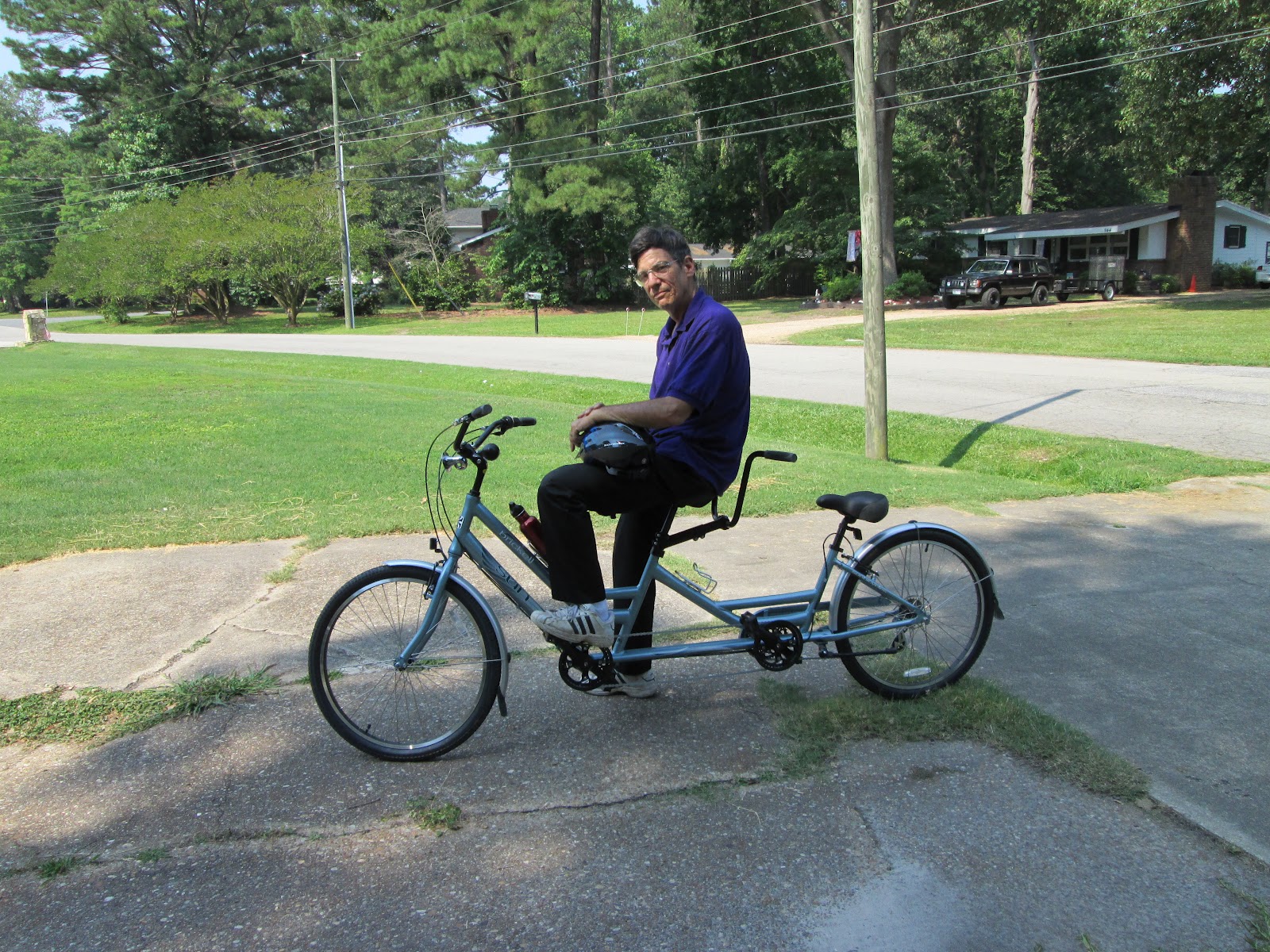
Don bought us a tandem bike. We first rode one together on our honeymoon on Ocracoke Island. To me, a "bicycle built for two" this has always been very romantic, like the old but corny song.

We took it out for our first spin today, and it moved like a dream, especially compared to the rental we'd had on our honeymoon. This bike has an aluminum frame, several gears, and is light and fast! It even comes in a color I like, a light blue. Don and I plan to put some baskets on it and to take it back and forth to the local grocery stores and for other light errands. It's fun, healthy, and will save on gas!

Sunday, June 17, 2012

Responses to "City Chicks Revisited"

I am getting responses on "City Chicks Revisited" by email and from other groups. With permission, I will post a selection of these reactions and responses here. Some are too good not to share. And, if you haven't already, please sign our online petition.

My favorite, so far, is from Kelly McGuire:

In response, I can only say that council can be loud, produce large amounts of waste resulting in obnoxious odors too. Their containment is sometimes difficult as well. I really have a hard time believing the sublime attitudes.

Here is one from  ~: Beth California Sierra foothills:~ via a Yahoo Group called "Breaking New Ground:"

A backyard flock of chickens need NOT be noisy, messy or anything negative. A clean coop/area will not attract flies, rodents. And chickens are actually great at eating ticks and other bugs which means less pesticides being used. Noisy? Bantam breeds are less noisy and many cities simply allow hens but no roosters. Roosters are the one who make the noise. Feed kept in a metal container wont attract rodents etc. Heck dog/cat/bird feeder food outside can attract rodents etc. Is the city/town going to ban those? Heck raccoons are more attracted to garbage cans than anything else. Are they banning garbage cans/pick up? The late actor Jimmy Stewart and his wife Gloria are the ones who got us back having chickens in the early 80's, when he shared how they had chickens in their Roxbury Drive, Beverly Hills home back yard. And if I do say so I think chickens make us better people. And yes you can quote me on that!

From Karen Anne Kirkpatrick  of the Facebook Group, "Backyard Chickens for Chesapeake:"


Can be loud, especially when playing.
Can produce large amounts of waste, resulting in obnoxious odors.
Waste in diapers fill our landfills.
Containment can sometimes be difficult.
Can be targeted as nuisances by other people, such as old people on the front lawn and college students texting on iphones....
  
Time to ban kids.

Another great response from Jack Newfield through the "Breaking New Ground" Yahoo Group:


>Can be loud
Hens are not loud and egg laying hens make no more noise than many automobiles. If egg-laying ducks are allowed, both sexes are very quiet.

>large amount of waste
No, there is far less odor from my 10 chickens than from my 3 dogs.

>Waste can attract rodents
So can an oak tree but that is allowed.

>Containment can be difficult
Containment is extremely simple. I don't contain mine at all and they do not range out of sight of their coop.

>Can be target of dogs
So can children and cats but they are allowed. It's the dog owner's fault if they are out of control. Cats do not attack hens.

So it's obvious they simply do not want to keep *low-status* animals in their neighborhoods. You'll find this with vegetable gardens too. Where flower gardens are permitted, vegetables are often prohibited because food is *low status* compared to flowers. Simple really.

The best way is the camel's-nose- in-the-tent approach, I believe. Get them to permit some eco thing that let's chickens in through the back door or get them to approve expensive show chickens and then buy ordinary hens and claim they are the same animal. It's all about status.

Saturday, June 16, 2012

City Chicks Revisited

 As I mentioned in an earlier post, I am spearheading a group of residents who are working to change the zoning laws in the City of Chesapeake, Virginia. The current zoning law states that residents must live in agricultural zones or on "residential estates" of three acres or more in order to keep laying hens. We would like to see micro-flocks of 2-6 hens allowed in most residential areas. Minutes of our most recent meeting are available online.

The city's initial response to our group's request was so weakly written and pathetic, I was actually saddened to read it. The response is available at the link to our minutes, above. It is not the well-informed, well-researched, and thoughtful response that our tax dollars deserve. Here are the main "impacts" against more residents keeping hens. I quote:

Chickens/hens...
    • Can be loud, especially when laying eggs.
    • Can produce large amounts of waste, resulting in obnoxious odors.
    • Waste can be an attractant for rodents.
    • Containment can sometimes be difficult.
    • Can be targeted as prey by other domesticated animals, such as dogs and cats.

That's it?  

Residents can legally keep prey animals like rabbits; they can keep household waste and birdseed, which attract rodents; they can keep dogs and parrots, which are noisy...but they can't legally keep 2-6 hens penned in their own backyards to turn their kitchen scraps into eggs? It's so ridiculous I feel like we are truly dealing with the fictitious bureaucrat on the XtraNormal satire that we've posted on Youtube.

If you feel as we do, there are ways you can help. Sign our online petition. If you are a Chesapeake resident, read our minutes, like our Facebook page, and get involved. By working together we will get the City Council's attention and, eventually, change.


For other responses to the City of Chesapeake's position, visit this followup post. For information on our speeches to the City Council on July 24 and the television and newspaper publicity we've been generating for our cause, read this post.

**Update 8/25/12: "4 Chesapeake Hens" and Councilman Robert Ike have convinced the City Council to send the  hen issue to Planning. We are inviting Pat Foreman, the author of City Chicks, to Chesapeake on October 9 for educational and awareness purposes. Click here for more information.

**Update 11/20/12: Chesapeake City Council approved a law that will allow up to six hens, no roosters, in a pen in residential backyards. There is a 1-year sunset clause on the ordinance.

Wednesday, June 13, 2012

Land Lobster?

My garden is doing splendidly this summer, despite a lack of sun. I have harvested enough Romaine lettuce for two huge, tasty bowls of salad for our family of three, I have given some away to two neighbors, and I still have some left to harvest. I have already planted more!
The squash plants are taking off!

The squash, pole beans, bush beans, and nasturtiums are doing great, too. I still have a few radishes left. All the amendments we added when we built the beds seem to be paying off. The weather has been hot and getting drier, but the soil still seems moist and the plants don't seem very stressed.

A recent mystery was a hole near one of my asparagus beds. I was afraid it was the entrance to a rabbit burrow. Something had been nibbling on my young pepper plants recently.

Don tried plugging up the hole to the burrow, but something kept digging up a new entrance every night. He finally got tired of it and dug the area up, but there was no sign of rabbits or a rabbit den.
Don's Hole

The mystery was solved this morning, when he saw what looked like a small lobster in the bottom of the hole. He killed it and put what was left of its corpse in a pail.
Yikes! Looks like a small lobster, but what is it?

After a little research, we determined that it was a crayfish. I always thought they lived in water, but there are some species that live on land, too, including the swampy areas of nearby North Carolina. This one apparently failed its geography lesson, or land crayfish are more widespread than people think. It's hard to find information about them, even online. If anyone knows of any good sources, please leave us a message below.

*** Update on 6/14/12: I have received a few emails about the crayfish from crayfish- and crawdad-lovers all over the country. Apparently, these "land lobsters" are common in other parts of the U.S., and I am told they are good cooking and eating if you are patient about picking out the meat.

I am a vegetarian, so I'll pass on that.

They are generally harmless except for the annoying holes from their tunnels around the lawn and garden. They actually tunnel down to the water table. They come out only at night and are opportunistic feeders and eat decaying vegetation and occasionally worms and bugs. In some areas they are called prairie crayfish. According to one website the latter are red and live in the grasslands of Missouri, so I doubt ours was that species. Texas prairie crawdads apparently include some rare species. If I learn any more about the species that live in Virginia, I'll post an update. I have also just learned that chickens love them and will gobble them up if given the chance. Since I want my own chickens, this is useful information. One reader says they will eat plants in nearby gardens, but I am not sure they can climb. The plants damaged in my nearby garden were in a raised bed, so I won't be quick to blame the crayfish. (The same reader later assured me that they can climb).

In the meantime I have requested of Don that if he finds any more of these interesting and colorful critters, he leave them be.