Showing posts with label chickens. Show all posts

Saturday, December 5, 2015

Avian Influenza and Small Flock Biosecurity

Whether we belong to 4 Chesapeake Hens, Hampton Roads Hens, or some other group, regional chicken keepers want to keep our backyard micro-flocks healthy. My husband, Don, and I attended a presentation in Suffolk on Wednesday with information on how to do that. The presenter was Dr. Tom Ray, DVM, MPH, VMO/Epidemiology, a veterinarian  who specializes in livestock. Aaron Miller, an AHT veterinary technician from Virginia Beach, assisted him. Both work with the USDA, a government agency, to raise public awareness to prevent the spread of communicable diseases in poultry and livestock.

A major concern right now is Avian Influenza or Bird Flu. It thrives in cooler temperatures and in humid environments and survives freezing. Wild birds carry it, particularly waterfowl, often without showing symptoms. It then gets spread by people and equipment, particularly on shoes and vehicles. There are two kinds: "low path," and "high path," depending on how pathogenic  the disease is. Low path is common, and an owner might not know their bird(s) have it unless they are tested, but the viruses mutate easily and can mutate into the high path type.

High path spreads rapidly, has a high mortality rate, and has a severe impact on trade, pets, backyard flocks, and exhibition birds. A recent outbreak of high path avian influenza was first detected in the U.S. in December of 2014 and ended in June of 2015. It affected 211 commercial flocks, 21 backyard flocks, 5 captive wild-bird facilities, and 100 wild birds in 21 states, mostly in the Mid-West, and cost over one billion dollars plus the lives of almost fifty million turkeys and chickens. Egg prices spiked last spring because of a resulting national shortage of commercial eggs.

Dr. Ray showed slides of turkeys infected with the disease. They suffered terribly, and all died within 24 hours of contracting the disease. The birds practically liquify; he says they are all feather and bones and liquid after 24 hours. (Eww!)

The scary part is there's a possibility the disease could hit the East Coast as waterfowl migrate this year. Officials are testing waterfowl like crazy and so far have only found low path, but flocksters need to keep in mind that can change.

An ounce of prevention is worth a pound of cure. The official term for prevention is "biosecurity." The main ideas are to keep a line of separation between your flock and possible vectors of disease, prevent contamination, and maintain cleanliness. The USDA has a fantastic website with all the details for backyard poultry keepers, so I won't repeat it here, but I urge readers to visit the site for more details.

Dr. Ray recommended cleaning all hard surfaces like shoes to remove mud or organic debris and then using a bleach solution or even Lysol to disinfect. Follow the recommendations on the Lysol can and read labels carefully: some types of Lysol work faster than others. A separate set of clothes and boots for visiting the hen house is also a good habit.

The USDA urges us to report sick birds. Due to the threat of high-path bird flu, the agency is taking calls of a dead chicken or two even more seriously than in the past. Please realize that pathologists prefer freshly dead or almost dead animals for necropsy and testing. Symptoms of avian influenza include swollen and purple-looking wattles and combs. Other symptoms are almost identical to Exotic Newcastle Disease. Watch for:
  • a sudden increase in deaths in a flock;
  • sneezing, gasping, coughing, and nasal discharge; 
  • watery and green diarrhea; lack of energy and poor appetite; 
  • a drop in egg production or soft- or thin-shelled, misshapen eggs. 
Report sick birds to:
  1. Your local Cooperative Extension Office,
  2.  Your local veterinarian or State Veterinarian, or
  3. The USDA Hotline at 866-536-7593. The USDA will come out for free and test your birds and take information from you to keep in a government database in case of future outbreaks.
 Speaking of the government, here is what the investigators will do if they first find a confirmed positive case of high-path avian influenza on a farm or other premises:
  1. Set up a control zone for a ten-mile radius and a buffer zone outside of the control zone.
  2. Set up movement restrictions into and out of the control zone with extra biosecurity measures
  3.  Test everything within it. 
  4. Depopulate infected flocks; see below.
 In the buffer zone, the government will test birds for free with your permission, but within the control zone, the government will test birds (again for free) with or without the owners' permission. This is allowed under Virginia state law.  Inspectors will go door-to-door looking for flocks. If a bird turns up positive for high path, they will "depopulate," meaning kill, the flock using fast and humane methods. Large factory-farms and large backyard flocks are suffocated en mass using a foam; backyard micro-flocks of five to ten birds are preferably wrapped in a towel to keep them calm and gassed with CO2 for ten to fifteen minutes. The incubation period for the disease is five days, so the last 5-10 day's worth of eggs must also be sought out and destroyed.

I know this idea is stressful for those of us who love our birds, but please realize the flock will NOT survive the high-path virus, the birds will suffer terribly dying, and while they die they will shed massive amounts of the virus. They will increase the risk of contaminating other flocks the longer they live. What seems cruel is actually an act of mercy and a prudent course of action. The government tries to depopulate the flock within 24 hours of receiving a positive result to minimize both suffering and the spread of disease. There is an indemnity process through which the government will pay for the death of live animals. The best way to avoid this awful scenario is to practice good biosecurity. Read these 6 Simple Steps we all can follow to keep our birds safe and healthy.

 We asked about the safest way to dispose of a dead chicken in general. Dr. Ray said the virus and other chicken diseases do not survive heat very well, so he recommends disposing of them in a burn barrel.

We should all follow good biosecurity practices. Even if we trust that nature and good care will protect our flocks, we should have a plan to "step up to" if high-path avian influenza is reported on the East Coast in the coming months.  As a public service, Wendy Camacho of Hampton Roads Hens has promised to make USDA-approved materials available at workshops and other events in coming months.

Thank you, Carol Bartram of PeCK, for organizing this important presentation for us.


Thursday, September 4, 2014

Sexing Chickens: Some Sound Advice


Those who mail order pullets in the cold winter months might be in for a surprise. Many companies pack unwanted rooster chicks around the pullets to keep them warm. Ask about this potential practice before you buy.

The following was written by Carol Bartram. I posted it here with her permission. Her words are both well written and wise. Thanks, Carol!


Hi, Chicken People,

The Chicken Chick has brought together a wealth of information about sexing chickens in this post:

The references at the end are also worth checking out! One of my faves that I didn't see listed is an article from Backyard Poultry Magazine (June/July 2011), also dispelling many of the myths you may come across in feed stores or elsewhere (thanks to Kathy for sending me this article):

In my opinion, one of the most important take-homes is that even professional vent-sexers are not 100% accurate, so please think ahead of time about what you will do if you do end up with a rooster and can't keep him. Unfortunately, you can't assume it will be easy to find him a good home where he will eat off of China plates, or that someone will pay you big bucks to purchase him. Ideally, you will have scoped out some options ahead of time, but if not, the LAST thing to do is to release him somewhere for him to become someone else's problem and give us backyard chicken-keepers a bad name. The SECOND TO LAST thing is to take him to an animal shelter (where he will become someone else's problem, etc...). A MIDDLE thing is to ask me to send out an e-mail looking for a home, or for you to post him on the Hampton Roads Hens Facebook page, where you'll reach a wider number of folks on the Southside who have room for roos. (There are also people who can, relatively humanely, process roos for you, if you choose to go that route. Old Dominion Hay in Smithfield has hosted classes to teach this skill.)

Hopefully, someday residential areas will get rid of their anti-rooster inclinations so that a bit of crowing won't be such a big deal, but I guess we have to get hens accepted first, and I think our efforts at being good neighbors will help a lot. I recently had a good talk with our newest neighbors about our rooster, and to my great relief they said they used to hear him, but now the only time they notice the sound is when somebody new comes to visit and asks if someone has a rooster. Whew --Quercus' lovely crow has faded into the background for them! I can see how a lot of roos talking to each other throughout the day in close quarters might be a different story...

Cluck and cock-a-doodle-doo,
Carol Bartram
Peninsula Chicken Keepers (PeCK)
peninsulachickenkeepers.weebly.com

Friday, August 1, 2014

Chickens and Grubs

Don and I are avid composters; Don probably more than I am. He reminds me of that old nursery rhyme about "snakes and snails and puppy-dog tails." Sometimes the more disgusting a project is, the more he seems to enjoy it. He likes to take care of and feed our kitchen composting worms, for example.

Actually, a properly-managed compost pile is far from disgusting. When well managed, compost piles do not smell unpleasant at all. But they do harbor a variety of bugs, microorganisms, and other things that I am not enough of a scientist to explain. Don seems to revel in this, particularly in the grubs.

Honestly, I think he revels in the grubs for their own sake ("snakes and snails..."). But he also likes to spoil our pets, and our four laying hens love nothing better than insects, particularly goodies from the compost pile, and especially grubs.

We are lucky that our climate is in "Zone 7" on the climate maps, which means that we are in the northernmost range of the Black Soldier Fly. These flies are voracious at eating up kitchen scraps to the point of being scary in a B horror-movie sort of way. And they make fantastic nutrition for the chickens, converting the kitchen scraps to fat, protein, and calories, which our dear hens then convert to eggs for us and fertilizer for our compost piles and garden.

Then the garden waste and kitchen scraps go into the compost pile, which then grows new larvae right up until the weather gets too cold for the soldier flies in the fall. Don has discovered that if he puts a big pile of "green" type kitchen scraps in the compost bin when the weather is warm, then covers that with a good layer of sawdust so it doesn't smell, then puts some chunks of fresh pineapple with the moist side down on top of the pile and the hard shell of the pineapple up toward the sky, then he can harvest black soldier flies by the handful (I shudder) to feed to our "girls," as folks in the U.S. call their chooks (a British or Australian name for backyard hens).

Black Soldier Fly Larvae Wriggle in the Remains of a Pineapple


I jokingly call Don their "rooster," because he brings them the choicest (to them) morsels and tries to make sure all the girls get their fair share, despite their jockeying and pecking order. And, believe me, they watch him closely and follow him around the yard, especially during composting season.


The Hens Watch Don Carefully During Composting Season


Don Makes Sure All the Chickens Get Their Fair Share
 Disclaimer: There is some risk of botulism, or "Limberneck," to chickens that eat fly larvae, especially if the grubs have grown in anaerobic conditions, such as in carcasses. For more information in general on raising Black Soldier Fly Larvae, check out this blog.

Saturday, December 21, 2013

Athena the Hen Visits the Vet

When you have backyard hens, one of the things you need to decide is to what extent these animals are for  food, and to what extent they are pets.

If you have hens mainly for the meat or even the eggs, then you will by necessity take a rather hard-nosed attitude towards birds that are aging, injured or sick. You will treat what you can with the help of extension agents or possibly veterinary diagnostic laboratories. You will want to treat birds as inexpensively as possible and will plan to cull (kill) birds that are old or otherwise beyond home treatment. If a bird dies suddenly, you might even perform your own necropsy. If the bird is healthy at the time she is culled, you will probably eat her. Hens that are past their prime as layers often make great soup, or so I'm told.  But truly sick birds need to be humanely culled and disposed of quickly and in a way that will minimize not only suffering but potential transmission of disease to the rest of the flock or to other animals.

If, like Don and I, you keep backyard hens  for not only eggs, but fertilizer for the compost pile, help with gardening tasks, and hours of entertainment, you may decide, like we did, that the hens are more pets than livestock. Ours have not only names, but personalities, too. We aren't competent enough to doctor them ourselves, so if our hens are sick, we plan to take them to a veterinarian.

 Athena, our Delaware, developed chronic loose stools ever since she molted back in late October or early November. I also feared she might be losing weight. My husband and I both thought she'd seemed lighter than last summer, and I noticed her breastbone stuck out more prominently than our other hens'. Because they are prey animals, chickens, like other birds, tend to hide signs of illness instinctively as a way of discouraging potential attacks by predators. By the time they actually show obvious signs of illness, they are usually extremely sick.

We decided not to risk this with Athena. Luckily, we have a great veterinarian  in Dr. Tony Poutous of Midway Veterinary Hospital  in Chesapeake, Virginia. He treats exotic animals including various types of birds and even chickens. When we brought our first three chickens home back in February, we made an appointment with Dr. Poutous for an initial exam and health check, so I knew he could tell us if she had lost weight since then.

The staff at Midway Veterinary Hospital in Chesapeake is ready to check us in

My husband, Don, waits with our hen (in a pet carrier) for our turn in the examining room


Even though Athena grew up on a farm, she is, like most chickens, an extremely good patient. It is particularly easy to get a stool sample from chickens, for example, because they poop a lot. Besides weighing her and taking a stool sample, Dr. Poutous gave her a careful physical exam. He did note that her stools were loose, although not alarmingly so.

Dr. Poutous' assistant takes down details for Athena's records before she weighs her.

Athena seems to like the scale and spent quite a bit of time there after being weighed.

Dr. Poutous arrives with a smile.

The doctor gets to work examining the patient; Don looks on.

Athena's loose stools were easy to observe (on the scale and on the examining room floor)

Much to our relief, Athena had actually gained a little weight since last spring, about 1/4 pound. Dr. Poutous still feels she's a little underweight, and he suspects she may have gained over the summer and then started losing weight again, since our impression was that she was heavier last summer. Her overall health and respiration seemed good upon examination. There were no parasite problems from the stool sample.

But she did have signs of a slight bacterial infection with clostridium. Dr. Poutous said that these bacteria are plentiful in soil. Since chickens live low to the ground and scratch in soil a lot, they tend to get exposed to it. He said it usually doesn't cause problems in them unless their immune systems are weakened or they suffer from stress. We had mentioned that Athena seemed to have a hard molt and that she'd been working harder than usual to maintain her status at the top of the pecking order in our flock. He suspects that these might be the kinds of stresses that could have allowed the bacteria to multiply to the point that they are giving Athena trouble.

Unlike other family pets, chickens produce food (eggs) and are potentially food (meat). Because of this, a veterinarian needs to be mindful of laws regarding use of medications in chickens. Luckily, Dr. Poutous knows his stuff. He said Athena needed an antibiotic, and he prescribed one (Metronidazole) that is safe and legal for use in chickens. He also gave us a withdrawal (discard) time of one month for Athena's eggs. This means nobody is allowed to eat her eggs for a month after she finishes her antibiotics, just to be on the safe side.

This is not a problem, because none of our girls is laying right now. They are heritage breeds, we do not supplement their light in the winter, and so they are taking a natural and much-needed break from laying. By the time they resume in the spring, we are hoping Athena's bout of poor health will be far behind her. Besides, we suspect Athena does not lay, anyway.

 By the way, according to Chicken Health for Dummies, "extra-label drug use in food-producing animals by anyone other than a licensed veterinarian is illegal. Some drugs are completely prohibited for food-producing animals--even veterinarians can't prescribe them for chickens. Examples of drugs on the no-no list are popular dog and cat antibiotics enrofloxacin (Baytril) and cephalexin (Keflex)." This is under U.S. Food and Drug Administration (FDA) rules.

Dr. Poutous had already warned us never to use Baytril in chickens, and I assured him that I would never give our hens an antibiotic without checking with him first. It really helps to have a diagnosis rather than playing guessing games with drugs and antibiotics, which can do more harm than good if misused.

So we feel his services are worth the money.

Sometimes friends or neighbors want to buy our eggs. I just laugh when they ask. The way we treat our hens, there's no point in charging for the eggs. We give eggs away or freeze them when we have extra. Competent veterinary care like what Athena gets from Dr. Poutous is not inexpensive. The examination, fecal analysis, and medication cost $129.00. He also wants a call if Athena does not improve, or if the loose stools come back.

Will do! We enjoy our birds and want to do right by them.

Update on 1/12/14: Athena seems back to her normal self, bossing the other hens around. Her stools are much better, so we are hoping she is cured for the long run. Thanks, Dr. Poutous!


Saturday, November 2, 2013

Chesapeake Chickens vs. Sunset: Soon Resolved?

Almost two years ago I started a Facebook Page, 4 Chesapeake Hens. Through this page I successfully organized a group that convinced our City Council to allow up to six laying hens on all single-family lots with certain restrictions. Chesapeake, Virginia, thus became a regional leader in the local foods, sustainability, and backyard chicken movement, with cities such as Portsmouth, Norfolk, Hampton, and Richmond later following suit by loosening up the legal restrictions that had prevented backyard micro-flocks. Of these, Chesapeake probably allows residents the most freedom. We have the shortest setbacks for the coop from the property line and no need for a license or inspection to have a flock. Coops must, however, comply with laws regarding accessory structures, so a permit for the coop is a definite possibility, depending on its size and structure.

Council put a one-year sunset clause on the new ordinance. This means that City Council must vote by December 20, 2013, to make the new law permanent, or Chesapeake's residential chickens will once again become illegal. Many people think this is highly unlikely unless backyard hens cause massive problems in the city, which they have not. This report, based on statistics acquired from the City under Virginia's Freedom of Information Act, shows that complaints about chickens in residential areas have actually decreased since the change in the law. And our group's contacts inside local government tell us that there have been few or no problems with chickens in residential areas since our group published this report.


Nevertheless, our group does not want to be complacent about our rights. During the late summer months we ran a "City Council Member of the Week" campaign, but with residential hens coming up on the agenda, we need to take further action. During a recent meeting of our leadership, here is what we have decided to do. This plan was revised on 11/4, when we were informed that hens will be on the agenda on November 26, NOT in December like we were originally (but tentatively) informed:


1. TJ "The DJ" Thompson will speak for our group as a "non-agenda" speaker on November 12. He will politely let Council know to expect contact from residents in favor of backyard hens.

2.  We will run a "thank-you note" letter-writing campaign from November 12 up to the vote on November 26, with brief but positive expressions of appreciation for the opportunity to keep hens. We recommend that these be very short and contain pictures for Council to view. These should be sent to the City Council members' home addresses as posted on the City's website. City Council has always appreciated how polite, well-informed, and positive our group is, and this occasion should be no different.


3. Members of our group are collecting letters of support from local businesses, neighbors, and civic groups. We hope to have these collected by the Friday before Thanksgiving, November 22, with an eye to having these copied and collated to present to Council by one of our speakers on the 26th. Or, better yet, send these directly to City Council in order to give members time to read them before the actual vote.

4. Council will have a work session on November 19 at 4:30 PM (subject to change). It would be great if one of our group could sit in on the meeting and report back on what was presented. I will go if I can, but I will not know until I know what time they meet. The public is not permitted to speak at work sessions, but they are open to the public. Council will also notice our presence there.

5. On the day of the vote, November 26, we will come to the City Council meeting with all the forces we can muster. We will wear the color green, the color of sustainability, so Council can see our numbers in the chambers. "Green means go!" in respect to continuing to allow us to keep our hens. We will make sure several of us sign up to speak that day, all with different, positive things to say about hens and our rights to keep them. Hopefully, Council will then vote to allow us to have them on a long-term basis.

Council meetings take place at City Hall at 306 Cedar Rd. They start at 6:30 PM, and anyone who wishes to speak must sign up in advance of the meeting. This can either be done at City Hall or by calling the City Clerk's office at 382-6151 during office hours of 8 AM through 5 PM weekdays.

 Update: On November 26, 2013, Chesapeake City Council voted to make the "hen ordinance" permanent. The meeting may be viewed online:  fast forward to 1:19 to see some great pro-chicken speeches and the City Council's reaction.

Sunday, April 14, 2013

Chickens as Lawn Mowers

As regular readers know, I started a community group, "4 Chesapeake Hens," where I live in Virginia. Our group got the law changed to allow up to six "female chickens" on all single-family residential lots with certain restrictions. There are setbacks for the coop from the property line, for example. There is also a sunset clause on the legislation, so the City Council will be revisiting the "hen issue" in October or November.

One of the reasons my husband and I wanted chickens was to help with gardening tasks such as fertilizing, tilling, compost-turning, and organic weed and pest control. What Don and I did not realize until we owned our own chickens is that they do a pretty nice job of helping to maintain parts of our back lawn and sparing us some of the use of our lawn mower. Since gas lawn-mower engines are both noisy and very polluting to the air, I now think our our hens as even more of a benefit to our local environment.

If you don't believe me, that's understandable. Folks picture chickens as dirty, smelly birds that burn the soil. But we are "urban chicksters," and our hens are kept in a portable coop and pen, also called a chicken tractor, that we move around the yard. By moving the pen frequently, we prevent the chickens from burning the soil and scratching and eating it bare. Instead they weed, graze, and slightly fertilize an area before we move them onto new ground.

This spring we had some lawnmower trouble and let the backyard go a little too long before the first mow. Our backyard is also fenced to separate the chicken/garden section from the dogs' run. Check out the differences in these sections of our yard as shown in the following pictures. I snapped them right before tackling the lawn with the mower. Keep in mind that NONE of this lawn has been mowed so far this year:

This is the area that has regularly been visited by the hens and intensively grazed due to the chicken tractor

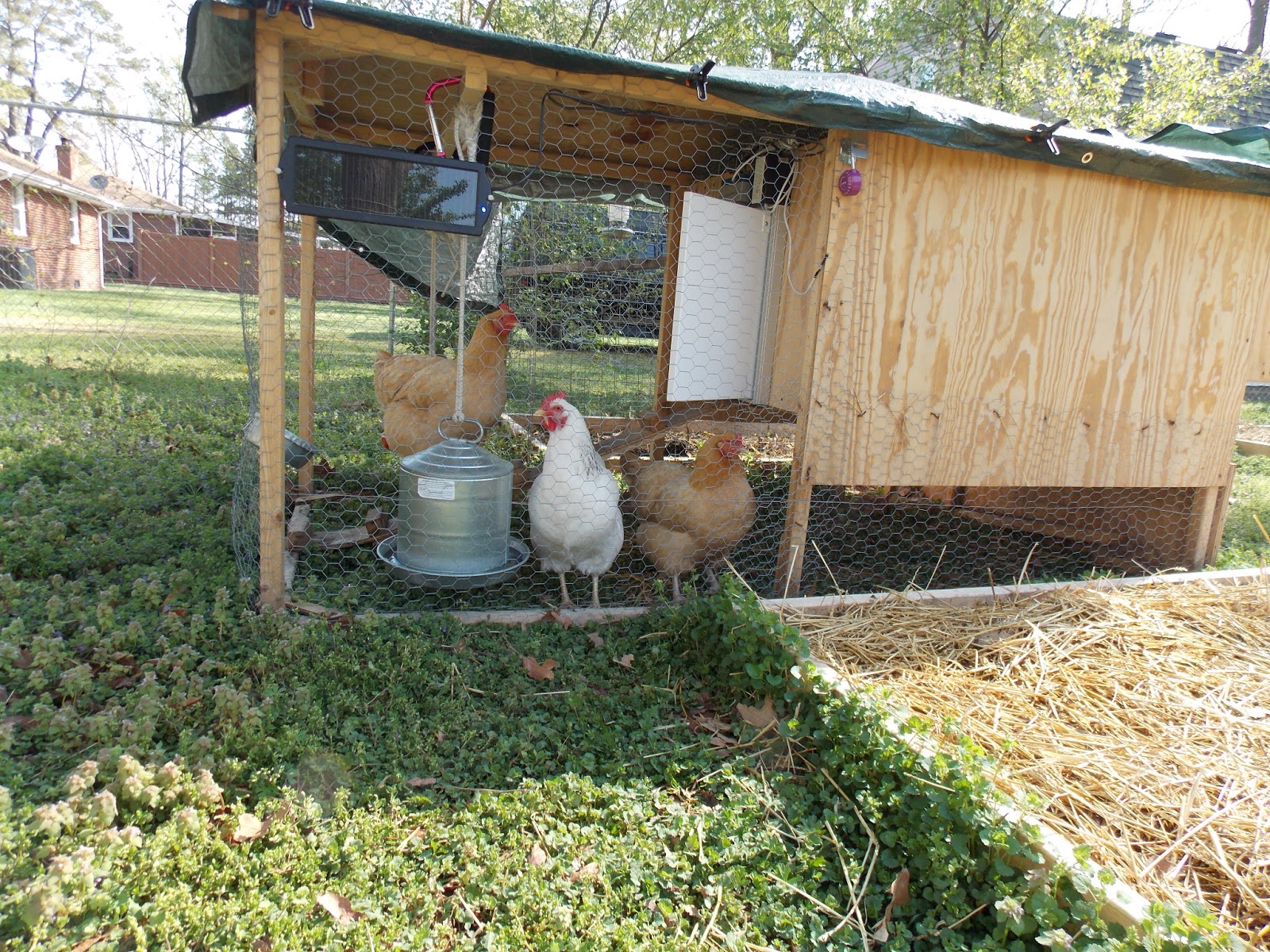
Don't know what I mean by a chicken tractor? Here are three of our girls saying hello!

The other two are working a compost pile/future garden from a pen attached to the tractor. Where there's no lawn, there's lots of high-carbon organic matter!

Here's an area of the lawn that gets occasional visits by the chickens but is too uneven for the tractor

Here's the same lawn where the chickens never go. The paths have been worn by our three dogs. What a difference!

Interested in seeing some hens up close and personal? Visit us during the Chesapeake Tour de Coop, held next Sunday (April 21, 2013, from Noon to 5 PM, weather permitting).

Saturday, November 17, 2012

When and Why Were Chickens Banned in Chesapeake? An Answer at Last!

4 Chesapeake Hens is a grass-roots organization that is trying to get micro-flocks of laying hens legalized in all residential areas of Chesapeake, VA. Currently the law only allows chickens on land zoned agricultural and on RE-1 "residential estates" of three acres or more. There, up to four hens (no roosters) may be kept in a pen. Up until yesterday, I have been unable to get factual information from the City regarding exactly when and why chickens were banned (see this previous post).

A member of City Council, Debbie Ritter, finally suggested I contact Dolores A. Moore, our City Clerk, with a request for more research on this topic. Yesterday I received an email that contained copies of minutes from both the Planning Commission and from the City Council where chickens were mentioned. These minutes date back to April 12, 1966, which is even before zoning was legally adopted in Chesapeake. Even then, there is a suggestion that the City preserve tracts of "two or three acres of land" for residents who desire to keep "ponies and chickens."

However, chickens and other poultry were allowed in the residential areas of Chesapeake up until June 17, 1975, when Council voted to allow "livestock, poultry, and other animals not commonly kept as pets" only in the A-1, RE-1, and (now defunct) C-1 Districts. The ordinance went into effect thirty days after its adoption. But even then the minutes make clear that it was the intention of the City to continue to allow residents who already had livestock to continue to do so under a "non-conforming use" unless the residents had stopped for one year, at which point they would not be allowed to begin again.

The only record of any objection to the new law was made by a Mr. Joseph T. Hall of 1385 Elbow Road at the Planning Commission meeting on May 19, 1975, which recommended the adoption of this ordinance. Mr. Hall owned a property zoned R-15s in the South Norfolk borough of Chesapeake, and he had tenants there who kept chickens. When informed that the ordinance "would prohibit the future keeping of animals not commonly classed as household pets on the property," Hall objected to the ordinance.

This ordinance must have generated some confusion or potential confusion about what constituted livestock, because on February 15, 2005, City Council Member Ritter made a motion to approve TA-Z-04-09, an ordinance "to clarify that rabbits, fish, and other animals can be kept as pets under certain circumstances." Council Members Burkhimer, Hayes, Krasnoff, de Triquet, Edge, Newman, Parker, Ritter, and Willis unanimously voted for the measure. Up to ten rabbits were allowed as pets under the ordinance, but domestic fowl were still prohibited.

These minutes answer the questions of when hens were prohibited, but not the question of why. Was the problem increased urban density, as Zoning Administrator John King once told me? Was it due to the mythical problems that chickens presumably cause? Or was there any evidence back in 1975 for the types of potential problems outlined in the Staff Report that 4 Chesapeake Hens has thoroughly rebutted?

To answer that question, I searched through old microfilms of newspapers from June of 1975. A few hours' search turned up an article from the Ledger-Star, dated Thursday, June 19, 1975.  I will quote from this article, "New Law Prohibits Farm Animals in City," below:

"The new regulation is based on a request by the council in January and generated from a claim for the city to pay the value of ducks killed in a residential zone.

"The claim was based on state law requiring cities and counties to reimburse residents when their livestock is fatally wounded by wild dogs.

"In the past several months, as more and more residents have asked for reimbursement from the city, the council has grown increasingly skeptical of their requests.

"When a Martin Avenue man asked for $93 to compensate for 19 ducks killed by stray dogs, Councilman J. Bennie Jennings Jr. noted the man lived in a district zoned for single-family homes on small lots. The Martin Avenue man received $53.30 for the loss of his ducks but the council voted to refer the question of proper zoning for livestock and poultry breeding to the Planning Commission. The city's planners recommended that farm animals be limited to three zoning districts. 

"Planning Department Director Milton Perry told the council the new ordinance would not apply to bonafide farms in areas subsequently zoned for residential use. 

"Also, the law would not affect persons in resmdential (sic) zones who currently maintain limited numbers of farm animals for their own use. Such situations would be classified as non-conforming uses and so long as such residents did not discontinue keeping farm animals for as much as two years they could keep their poultry and livestock."

With subsequent changes that have been made in state and local laws, the potential for residents with poultry to run the City's coffers dry with spurious livestock claims has been prevented, as explained in 4 Chesapeake Hens' "Further Information" document, pp. 9-11. And it is clear that the original intent of the law was to limit "poultry breeding," not the keeping of a few chickens for household use. Therefore there is no reason that the current Council cannot undo the unnecessary restrictions that have been imposed upon Chesapeake's residents over the years as an unintended consequence of this law. Flocks of up to six laying hens, kept in pens, should be allowed in all single-family residences, for all the reasons explained on this website and elsewhere.

If you  agree with us, be sure to arrive at the City Council meeting this Tuesday, November 20, at 6:30 PM at City Hall on Cedar Rd. Come dressed in red and sit with us. If you desire to speak, you must sign up to speak BEFORE the meeting begins, however. Remarks are limited to five minutes and may be cut to three depending on the number of people speaking. Let City Council know you support TA-Z-12-07 with changes to allow the keeping of up to six hens and the removal of the privacy fencing requirement.

**Update: On November 20, 2012, Councilman Robert Ike made a motion to allow up to six hens, in a pen, on residential properties on single-family lots. The motion carried, 6-3.


Sunday, October 21, 2012

Overlay Districts vs. Chesapeake Hens

Our group, 4 Chesapeake Hens, is trying to get micro-flocks of up to six laying hens legalized in residential areas in Chesapeake, Virginia. The Planning Commission has voted against our initial efforts to do this by one vote in a split decision. We may never know the Commissioners' true reasons for voting against us because there was no public discussion or debate against the chickens at the meeting. Those who voted against us have not even given us reasons in our follow-up contacts with them, other than something vague to the effect that the Staff Report seemed thorough and sufficient.

Except that it was not. Our group has researched further information on the Staff Report that we intend to share with City Council. In the meantime, the part of the Staff Report that disturbs me the most is this one:


 ... It's me, again. What bothers me most about this portion of the document is that it is completely clueless about the "urban homesteader" point of view or the other national movements that are behind the interest in gardening. It is clueless regarding WHY an interest in urban chickens is sweeping this nation. Why should hens be banned due to something as arbitrary as an overlay district, if there is nothing intrinsically undesirable about the chickens? We are not asking for a dismantling of these districts, but merely permission to keep a few chickens like any other pet. Doing so will make Chesapeake an even better, more desirable place to live. Residents will be able to enjoy organic gardening and permaculture without leaving their own yards.

Here we are, doing our best to combat urban sprawl and preserve the environment. We also want to live in the residential areas where infrastructure is already in place to support our homes. Some of us are taking older, beat-up homes in residential areas and fixing them up. We hire local remodeling, heating and air-conditioning companies, and other local businesses to do this, thus contributing to the local economy. We generally spend our local dollars as locally as we can.

We want a small spread to reduce our need for lawn mowing because this process takes a lot of time and is very polluting. We are trying to lessen the impact of our properties even more by replacing relatively unproductive lawn that requires mowing with useful vegetable gardens that do not. We desire to live close to our work and recreational activities to save on time and fuel. Our commitment is to residential areas, and we see hens as part of our environmental commitment and as assistants in fertilizing and maintaining these lawns and gardens without the use of fertilizers, herbicides, pesticides, and other products made from petroleum. They will even help us till our garden beds without the use of noisy, smelly, gasoline-powered tools.

While some of us can't afford to move to a farm or an RE-1 residential estate, others do not want to do so even if we can afford to. The Staff Report suggests that we add to urban sprawl and to the long lines of automobiles sitting on Highway 64 every weekday morning and afternoon. It suggests we burden the City with the need for even more roads and other infrastructure to support this sprawl, all at taxpayer expense. It tells us the solution is not to object to the restrictions regarding laying hens, but to simply move if we don't like this arbitrary and unnecessary policy under the current overlay districts. And it is somehow confident that residents who are willing to give up other amenities and move for the sake of a few chickens will choose to remain in Chesapeake, instead of looking somewhere in North Carolina or elsewhere where the taxes are lower. Does this sound like sound, proactive city planning as our nation watches fuel prices spike and the approach of peak oil? Is it well-considered in a time of prolonged recession and difficult-to-obtain home mortgages? And if residents of the residential overlay district are so vehemently opposed to a few pet hens next door, where have they been at the public hearings on this matter?

Furthermore, I fail to see how a few pet chickens can threaten an entire overlay district, while a few pet parrots or rabbits cannot. This is totally overblown and illogical.

Our group is far from done in making its case before City Council. Others interested in helping with this effort are urged to contact City Council members, to like our Facebook page, and to sit with us, dressed in red, at City Council meetings. The most important of these is coming up on November 20, 2012, when the "hen issue" is back on the agenda for City Council. The meeting starts at 6:30 PM. If you care, BE there!

Update: On November 20, Chesapeake City Council voted 6-3 to allow hens with certain restriction in residential areas.